Air-suspension systems are the highest-stakes specialty within the European luxury auto-parts aftermarket. A failed front air strut on a Range Rover, Mercedes S-Class, BMW 7-Series, Audi A8/Q7, or Porsche Cayenne typically costs USD 1,800-3,800 per corner at OE dealer pricing — for a single vehicle that needs all four corners refreshed, the bill exceeds USD 7,000-15,000 quickly. Aftermarket-fit air-suspension components from a Chinese specialist factory deliver the same dimensional and functional fit at FOB prices 75-90% below OE dealer pricing, opening up a high-margin segment for workshops and parts distributors who can navigate the technical complexity properly.
This guide is the third companion piece in our Hongmodi Auto Parts series — distinct from the general European suspension guide (steel-spring chassis components) and the turbo and engine-parts guide — focused exclusively on air-suspension struts, air springs, electronic dampers, and the supporting compressor and valve-block components that make adaptive suspension work.
Product range — actual catalogue images
The product images below are hosted on the manufacturer's official website (hongmodiautoparts.com) and link directly to the manufacturer's catalogue. Click any image to view the full specification page in a new tab.
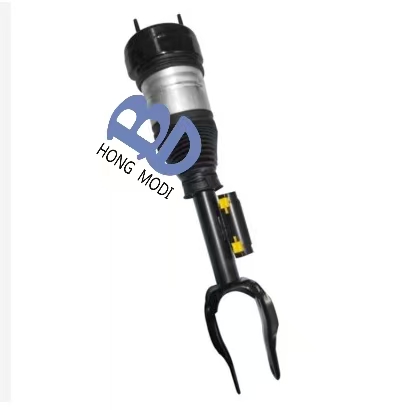
Front air-suspension strut with electronic damping connector — premium European OE-equivalent.
View on supplier site →
Polished aluminum front air strut with electronic-damping interface (red connector).
View on supplier site →
Front air strut with adjustable mounting bracket — alternative configuration for same-platform vehicles.
View on supplier site →
Rear air spring — rolling-lobe design, replaces original rubber bag for the rear axle.
View on supplier site →
Hydraulic damper / shock absorber with electronic connector — pairs with air spring on adaptive suspension.
View on supplier site →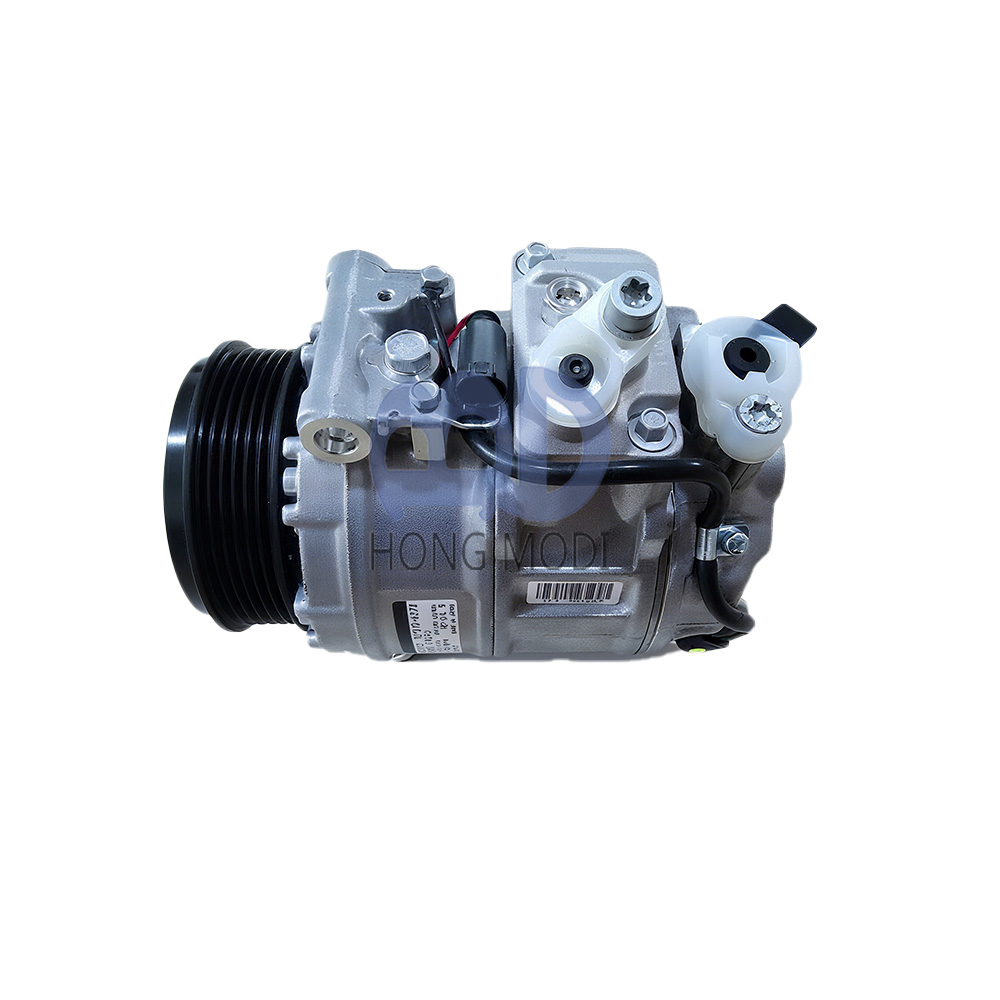
AC compressor for European luxury — clean part shot, complementary engine-bay component.
View on supplier site →Why air-suspension is a separate specialty
Air-suspension is fundamentally different from steel-spring suspension in three ways that affect aftermarket sourcing:
| Dimension | Steel-spring suspension | Air suspension | Aftermarket impact |
|---|---|---|---|
| Spring element | Coil spring or torsion bar (passive) | Air bag (rolling lobe or convoluted) — adjustable pressure | Air-bag rubber compounds need specialized manufacture; not all Chinese factories can produce reliably |
| Damping | Hydraulic shock absorber (passive) | Electronic damping (variable force via solenoid valve) | Electronic connector, calibration data, OE-equivalent valving curves all required |
| System integration | Standalone parts | Compressor, valve block, ride-height sensors, ECU all interlinked | Replacement of one component must be compatible with the rest of the network |
| Service life | 10-15 years typical | 6-10 years on air bags; 8-12 on struts | Higher replacement frequency = higher revenue per vehicle |
| Diagnosis complexity | Visual + bounce test | Diagnostic scanner required for ECU-level fault codes | Workshop must be equipped for VAG-COM, STAR Diagnosis, or similar tools |
Vehicle applications and their service intervals
| Vehicle platform | Air-suspension type | Typical failure interval | Most common failure |
|---|---|---|---|
| Range Rover (L322 / L405 / L460) | 4-corner air with electronic damping | 5-8 years on air bags; 7-10 years on struts | Air bag perforation (especially in salt-belt markets) |
| Land Rover Discovery 3/4/5 | 4-corner air | 6-9 years on air bags | Air bag failure + valve block leakage |
| Mercedes-Benz S-Class (W221, W222, W223) | 4-corner Airmatic with ADS | 6-9 years on struts (front load-bearing) | Front strut leak around top mount; ADS valve electrical fault |
| Mercedes-Benz GL/GLE/GLS (X166, X167) | 4-corner Airmatic | 5-8 years on rear air springs (load-cycling) | Rear air spring rubber fatigue |
| Mercedes-Benz E-Class Airmatic (W212, W213) | 4-corner Airmatic optional | 7-10 years | Rear air strut leak; compressor failure |
| BMW 7-Series (G11/G12/G70) | 2-axle adaptive air (rear-only on some trims) | 6-9 years | Rear air spring; compressor-relay failure |
| BMW X5 (E70/F15/G05) and X7 | Rear adaptive air or 4-corner air | 6-9 years | Rear air spring leakage |
| Audi A6/A7/A8 (C7/C8 platforms) | Adaptive air w/ optional electronic damping | 7-10 years | Front strut top mount fatigue |
| Audi Q7 / Q8 (4M, 4M Mk2) | 4-corner adaptive air | 6-9 years | Air spring perforation; height sensor faults |
| Porsche Cayenne (9PA / 92A / 9YA / 9YB) | 4-corner adaptive air w/ PASM | 6-10 years | Front strut leak; PASM-valve electrical fault |
| Porsche Panamera (970 / 971) | Adaptive air optional | 6-9 years | Rear air spring fatigue |
| Volkswagen Touareg (7L / 7P / CR) | 4-corner adaptive air | 6-9 years | Air spring failure; compressor wear |
| Bentley Continental GT / Flying Spur | 4-corner adaptive air w/ active anti-roll | 5-8 years | Front strut electrical connector + air spring |
| Tesla Model S / X | 4-corner Smart Air Suspension | 5-8 years | Compressor + valve block (well-known failure points) |
| Lexus LS / LX (URJ / VJA) | 4-corner adaptive air | 7-10 years | Front strut leak; rear shock electronic fault |
Air-suspension component pricing brackets
| Component | FOB China premium aftermarket | Tier-1 brand (Arnott / Bilstein / Continental) | OE dealer |
|---|---|---|---|
| Front air strut (single, with electronic damping) | USD 220-580 | USD 480-1,100 | USD 1,400-3,800 |
| Front air strut (single, no electronic damping) | USD 150-380 | USD 320-680 | USD 950-2,200 |
| Rear air spring (single, no shock) | USD 65-180 | USD 160-380 | USD 420-980 |
| Rear air shock (single, with electronic damping) | USD 180-450 | USD 380-850 | USD 1,100-2,400 |
| Air compressor (assembly) | USD 110-280 | USD 250-580 | USD 680-1,650 |
| Air compressor relay | USD 8-25 | USD 18-45 | USD 65-180 |
| Valve block / distribution block | USD 95-280 | USD 220-580 | USD 580-1,400 |
| Ride-height sensor (each) | USD 18-65 | USD 45-140 | USD 180-420 |
| Air-line / pneumatic tubing kit | USD 22-65 | USD 55-140 | USD 180-450 |
| Top mount / strut bearing (each) | USD 25-75 | USD 65-180 | USD 180-450 |
Quality tier definitions for air suspension
| Tier | Air-bag rubber | Damper valving | Service life vs OE | Price ratio |
|---|---|---|---|---|
| Premium aftermarket-fit | EPDM or chloroprene with reinforced fabric layers; OE-equivalent rubber compound | Multi-stage valving matched to OE damping curves; OE-equivalent ECU calibration data | 85-100% of OE | 15-22% of OE |
| Standard aftermarket | Standard EPDM with single fabric layer | Simpler valving, may not perfectly match OE damping | 55-75% of OE | 8-15% of OE |
| Budget | Low-grade rubber, susceptible to ozone and heat aging | Basic valving, no electronic damping integration | 30-50% of OE | 4-8% of OE |
Why air-suspension tier matters
Air-suspension failure consequences range from "vehicle settles overnight" (annoying but not dangerous) to "vehicle refuses to start due to ECU air-suspension fault" (immobilizing). For European luxury vehicles where customers expect 120,000-200,000 km of service from any major component, budget-tier air struts that fail at 40,000-60,000 km generate severe customer dissatisfaction and warranty disputes. Premium tier is strongly recommended for all customer-vehicle work; budget tier is acceptable only for end-of-life vehicles where customer has explicitly accepted shorter service life.
Air bag rubber quality is the single most important specification. Look for: EPDM or chloroprene base compound (NOT generic NBR), reinforced multi-fabric layers (NOT single layer), ozone-resistant additives, temperature range -40°C to +120°C tested. Premium-tier suppliers like Hongmodi use OE-equivalent rubber compounds with documented test data; budget-tier suppliers cannot provide this documentation.
Pre-installation requirements specific to air-suspension
- Diagnostic scan first — connect VAG-COM, ISTA, STAR Diagnosis, or PIWIS to read air-suspension ECU fault history. Often reveals issues beyond the visible component (compressor failure causing strut "failure," valve block fault causing pressure issues)
- Verify compressor health — compressor cycle test before installing new struts. A failing compressor causes new struts to fail prematurely from over-pressurization or under-pressurization
- Inspect valve block — leaks at the valve block can cause air struts to leak down even when struts themselves are perfect. Pressure test the valve block before strut replacement
- Check ride-height sensor calibration — incorrect calibration causes constant air-spring pressure adjustment, accelerating wear
- ECU re-calibration after install — ride-height re-learning required after any air-strut replacement; some platforms also require damper-curve recalibration
- Air-line inspection — old plastic air lines can crack or develop micro-leaks; replace any line showing age or damage
Skipping these pre-installation steps cuts service life of new air-struts from 6-10 years to 1-3 years. Document the procedures performed and warn customers that warranty does not cover failures caused by skipped diagnostic steps.
Distributor inventory strategy
Air-suspension components have higher per-unit value but lower unit volume than typical aftermarket parts. Inventory strategy should reflect this:
| SKU category | Stock level for typical European-luxury distributor | Reorder logic |
|---|---|---|
| Front air struts (top-velocity vehicle platforms) | 2-4 sets each per top-10 platform | Maintain 6-10 weeks of consumption; air-freight on stockout |
| Rear air springs / shocks | 2-4 sets each per top-10 platform | Same as front |
| Air compressors | 1-2 each per top-10 platform | Slower-moving but high-value; air-freight on stockout |
| Valve blocks | 1-2 each per top-5 platform | Low-volume but critical for completing repairs |
| Ride-height sensors | 3-5 each per top-10 platform | Higher failure rate than struts in some markets |
| Top mounts / strut bearings | 5-10 sets each per top-10 platform | Always replaced with strut work; high attachment rate |
Container loading economics
| Order tier | MOQ (mixed SKUs) | Discount | Container utilization | Lead time |
|---|---|---|---|---|
| Sample / specialist trial | 1-3 sets each SKU | List price; air courier | DHL / FedEx | 5-10 days |
| Specialist workshop | 20-60 sets total | 5-12% | LCL or pallet | 15-25 days |
| Small distributor | 120-350 sets total | 15-22% | 20' container | 25-40 days |
| Mid distributor | 500-1500 sets total | 22-32% | 40' or 40HQ container | 40-60 days |
| Large distributor / brand | 2000+ sets total | 32-42% | 40HQ x N | 60-90 days |
A 40HQ container of mixed air-suspension components typically holds 800-2,000 units depending on size mix (small ride-height sensors pack densely; large air struts are bulky). Container FOB value is significantly higher than for general suspension parts: USD 80,000-180,000 typical for first container of a serious air-suspension distributor.
Order workflow — air-suspension specialist procurement
- Vehicle parc analysis — identify the dominant air-suspension-equipped luxury vehicles in your local market by registration data
- Failure-mode analysis — for each top-10 platform, document the typical failure mode and component most often replaced (front strut for some platforms, rear air spring for others, compressor for Tesla, etc.)
- SKU mix — typical first wholesale order: 60% air struts (3:1 ratio of front:rear depending on platform failure mode), 15% air springs, 12% compressors + valve blocks, 8% sensors + top mounts, 5% specialty
- Quality verification — bench-test pressure cycle each SKU against OE specification; verify electronic damping calibration data per ECU platform
- Sample workshop installation — install on actual customer vehicles, run diagnostic scans pre/post, verify ECU acceptance + ride-height learning success
- First container order — 350-800 sets total mixed across 40-80 SKUs based on local platform analysis
- Series replenishment — quarterly air-suspension orders + monthly air-freight top-up for fast-movers; maintain warranty stock kit (typically 3-5% of fleet) for legitimate field-failure replacements