weisourcing.com / products / ALCOKSON / Alcohol Breathalyzers & Interlock Devices

Alcohol Breathalyzers & Ignition Interlock Devices from China — A Specialty B2B Buyer's Guide

A practical sourcing guide for alcohol breath testing equipment from China — written for fleet management companies, workplace safety program managers, industrial safety equipment distributors, court-mandated ignition interlock service providers, healthcare and occupational medicine clinics, and consumer/personal-use resellers. Real product images from alcokson.com covering handheld personal breathalyzers, professional-grade fuel-cell units, wall-mounted and station-style breathalyzers with face recognition, ignition interlock devices for vehicles, calibration equipment, and consumable mouthpieces. Sensor technology comparison (semiconductor vs electrochemical fuel cell), product categories with pricing, application markets (fleet / workplace / law enforcement / IID / consumer), certification requirements by destination market (DOT, NHTSA, OIML R 126, EN 15964, EN 16280, state-specific IID approvals), and the procurement workflow for alcohol testing equipment programs.

Manufacturer: ALCOKSON (alcokson.com)
Category: Battery & Energy Storage
Reading time: 13 min

Alcohol breath testing equipment serves a specialized but high-stakes B2B market: fleet operators managing driver compliance, workplace safety programs in mining and heavy industry, law enforcement agencies, court-ordered ignition interlock programs for DUI offenders, occupational health screening, and bars/restaurants for self-service patron testing. The technology divides into two distinct categories: semiconductor sensors (lower cost, suitable for screening) and electrochemical fuel cell sensors (higher accuracy, required for evidential and legal-compliance use). Demand for breathalyzer equipment has expanded significantly with stricter workplace alcohol policies, expansion of fleet safety programs, and ignition interlock mandates in many US states and other jurisdictions for DUI offenders.

This guide covers the ALCOKSON product family — handheld personal breathalyzers, professional-grade fuel-cell units, wall-mounted and station-style breathalyzers with face recognition, ignition interlock devices for vehicles, calibration equipment, and consumable mouthpieces. Real product images linking back to the supplier's catalog at alcokson.com.

Product range — actual catalogue images

The product images below are hosted on the manufacturer's official website (alcokson.com) and link directly to the manufacturer's catalogue. Click any image to view the full specification page in a new tab.
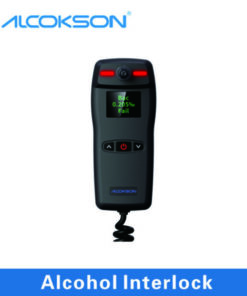
Handheld breathalyzer with carry case — ALCOKSON-branded portable alcohol detection device.

Handheld breathalyzer with carry case — ALCOKSON-branded portable alcohol detection device.

View on supplier site →
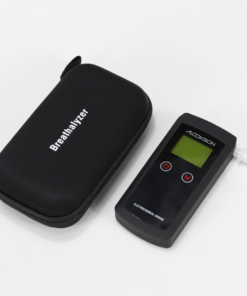
ALC-215D handheld breathalyzer with case (

ALC-215D handheld breathalyzer with case ("Breathalyzer" labeled) — fleet inspector / compliance use.

View on supplier site →
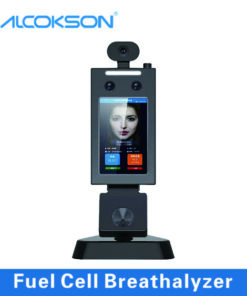
Wall-mount fuel-cell breathalyzer with face-recognition tablet — workplace entrance / station application.

Wall-mount fuel-cell breathalyzer with face-recognition tablet — workplace entrance / station application.

View on supplier site →

Sensor technology — the fundamental distinction

Sensor typeAccuracyService lifeCalibration intervalCost levelBest for
Semiconductor (MOS)±0.01-0.02% BAC at 0.05% level1,000-3,000 tests typical3-6 months or after 200-500 testsLowestPersonal screening, low-volume use
Electrochemical fuel cell (basic)±0.005-0.010% BAC at 0.05% level5,000-20,000 tests6-12 monthsMidProfessional screening, fleet operations
Electrochemical fuel cell (premium)±0.003-0.005% BAC at 0.05% level20,000-100,000 tests12 months typicalHighLaw enforcement, court-evidential, ignition interlock
Infrared spectroscopy (lab/clinical)±0.001-0.003%Permanent (calibrated)AnnualHighestHospital, lab, court-evidential primary

Why semiconductor vs fuel cell matters

Semiconductor sensors detect alcohol indirectly through tin oxide film resistance change — they respond to alcohol but also to acetone, methane, and other volatiles, leading to false positives in some scenarios. They're fine for personal screening ("am I OK to drive?") where occasional false positive is tolerable, but inappropriate for legal/compliance use where accuracy and specificity matter. Fuel cell sensors use an electrochemical reaction specific to ethanol, with much better accuracy, repeatability, and specificity. For any legal, compliance, or court-related use, fuel cell technology is essentially mandatory.

Product categories and pricing

ProductSensorFOB China per unitAnnual consumables (mouthpieces)
Personal pocket breathalyzerSemiconductorUSD 8-22 per unit50-100 mouthpieces × USD 0.05-0.18
Personal premium pocketSemiconductor (high-grade)USD 18-45 per unitSame as above
Handheld professional (fuel cell)Fuel cell basicUSD 65-180 per unit500-2000 mouthpieces × USD 0.05-0.18
Handheld premium (fuel cell)Fuel cell premiumUSD 180-450 per unitSame as above
Police/evidential gradeFuel cell premium + DOT/EU certificationUSD 380-1,200 per unitPer-test mouthpiece tracking required
Wall-mounted fixed stationFuel cell premium + tablet/face recogUSD 580-2,400 per unit5,000-20,000 mouthpieces annually
Vehicle ignition interlockFuel cell premium + GPS + cameraUSD 380-1,200 per unitService contract typically required
Calibration gas (alcohol simulator)N/AUSD 18-45 per cylinderUsed for sensor calibration; per-device
Mouthpiece (single-use, individually wrapped)N/AUSD 0.05-0.22 per pieceBulk purchase 1000+ at lower cost
Calibration service kitN/AUSD 38-120 per kitFor periodic recalibration

Application markets

ApplicationEquipment requirementVolume per program
Trucking fleet (driver pre-shift testing)Handheld fuel cell, mid-grade1 unit per 5-15 drivers (rotation); 100-500 units per major fleet
Bus / transit fleetHandheld + occasionally fixed station1 unit per 8-20 drivers; centralized testing locations
Mining / construction (workplace safety)Wall-mounted at site entrance, optional handheld for foreman1-3 fixed units per site; 5-20 handheld for supervisors
Manufacturing / industrial workplaceWall-mounted at entrance for high-risk operationsPer-site basis; growing adoption
Law enforcement (roadside / station)Premium fuel cell + evidential gradeState/national contracts; thousands per program
Court-mandated ignition interlock (DUI program)Vehicle interlock + service contractState-by-state programs; 10,000-200,000 units per state program
Bars / restaurants (patron self-service)Coin-operated wall unit1 per location for risk-averse establishments
Healthcare / occupational medicinePremium fuel cell, calibratedPer-clinic basis; modest volume
Personal/consumer retailPersonal pocket unitsMass market; e-commerce + retail distribution
Aviation / specialty industriesPremium fuel cell, often customizedPer-company programs; high-precision requirements

Compliance and certification requirements

StandardScopeMarkets where required
DOT (Department of Transportation) approvedUS commercial driver alcohol testing per 49 CFR Part 40USA — required for FMCSA-regulated drivers
NHTSA conforming products listUS evidential breath testingUSA law enforcement
OIML R 126International standard for alcohol breath analyzersEU, many other markets
EN 15964 (EU)European standard for breath alcohol analyzersEU
EN 16280 (EU)Personal breath testersEU consumer market
CE markingEU complianceEU / EEA
FCC certification (radio, if equipped)US wireless compliance for connected devicesUSA
RoHSHazardous substance restrictionsEU; expanding globally
State-specific ignition interlock approvalEach state in US has approved-device listUSA state-by-state
Calibration traceabilityNIST or equivalent reference standardRequired for evidential / court use

Regulatory complexity for ignition interlock devices

Ignition interlock devices (IID) are heavily regulated in the US — each state maintains its own approved-device list, and getting on multiple state lists requires individual state certification (often USD 25,000-150,000 per state plus annual renewal fees). For Chinese aftermarket-fit IID manufacturers, US market entry typically requires (a) partnership with an established US service provider who handles state certifications, (b) volume commitments to justify certification investment, (c) ongoing compliance with state-specific reporting requirements. Without state-by-state approval, IID hardware cannot be legally sold for court-mandated programs in that state. EU has Type Approval requirements through national authorities. Practical implication: most Chinese IID manufacturers focus on private workplace applications (less regulatory complexity) rather than court-mandated programs which require local certification partnerships.

Common buyer profiles

Buyer typeTypical order pattern
Fleet management companyAnnual: 50-500 handheld units + ongoing mouthpiece supply
Workplace safety program (mining, construction)Project: 5-20 fixed wall units + handheld for supervisors; ongoing supplies
Industrial safety equipment distributorContinuous: full catalog stock with fast-moving consumables
Government / law enforcement agencyMulti-year contracts; tens of thousands of units; rigorous certification requirements
Court-mandated IID service provider (US)Continuous: hardware + service contracts; state-certified products only
Personal / e-commerce resellerContinuous: high-volume low-margin mass-market personal units
Healthcare / occupational medicine clinicPeriodic: 1-5 premium units per clinic with annual recalibration
Hospitality / bar servicePer-location: 1 coin-operated unit + ongoing mouthpiece supply

Order workflow — alcohol testing equipment procurement

  1. Application analysis — define use case (screening vs evidential, fleet vs workplace vs personal); map technical requirements (sensor type, calibration interval, connectivity, certifications)
  2. Compliance specification — verify destination-market and application-specific certifications required (DOT for US fleet, OIML R 126 for international, state-specific for IID, evidential standards for law enforcement)
  3. Sample / pilot order — 5-25 units of each candidate model; verify accuracy with reference solutions, evaluate ergonomics, test mouthpiece supply, verify connectivity (Bluetooth, app integration if applicable)
  4. Calibration verification — verify supplier provides calibration certificates; understand recalibration interval and process; budget for ongoing calibration
  5. First wholesale order — typically 50-500 units depending on application; specify exact configuration, mouthpiece compatibility, calibration certificate per unit
  6. Quality acceptance — incoming inspection per AQL 0.4% for major (calibration accuracy), 1.0% for minor (cosmetic, packaging); verify each unit operates within specification
  7. Mouthpiece supply — establish ongoing mouthpiece supply with proper hygiene packaging; budget annual consumable cost; consider air-freight on stockout
  8. Calibration service plan — establish recalibration program (3-12 month interval); budget annual recalibration cost; document per-unit calibration history for legal/compliance use

ALCOKSON on weisourcing.com

View the full supplier profile, certifications, contact details, and complete product catalogue.

Frequently asked questions

Why is the difference between semiconductor and fuel-cell sensor so critical?
The technical and legal implications are significant. SEMICONDUCTOR SENSORS use a tin-oxide film whose electrical resistance changes when exposed to alcohol vapor. Cheap to produce, fast response, but they respond to many compounds (acetone from ketogenic diet, methane, smoke, mouthwash residue) that can cause FALSE POSITIVES. Service life is limited (1,000-3,000 tests typical) and accuracy degrades over time. Best for personal screening where false positive is acceptable (you take a second test or wait 30 minutes). Cost: USD 8-45 per unit. FUEL-CELL SENSORS use an electrochemical reaction specific to ethanol. Much better accuracy, fewer false positives from non-alcohol compounds, longer service life (5,000-100,000 tests), and better repeatability across the BAC range. The technology is the same fundamentally as evidential breathalyzers used by police. Cost: USD 65-1,200 per unit. LEGAL IMPLICATION: in any context where the test result has consequences (employment decision, court proceeding, denial of vehicle start), fuel-cell technology is essentially required. Semiconductor results can be challenged on accuracy grounds and may not be admissible. WORKPLACE/FLEET application: fuel-cell mid-grade is the practical choice — affordable enough for fleet deployment but accurate enough that policy decisions based on results are defensible. Personal/consumer use: semiconductor is fine for self-screening before driving.
How does the calibration process work and how often is it required?
Calibration is essential for accurate alcohol testing. CALIBRATION PROCESS: a known concentration of alcohol vapor (from a wet alcohol simulator at controlled temperature, or from a dry-gas calibration cylinder with certified concentration) is presented to the breathalyzer. The device measures the calibration sample and adjusts internal calibration constants to read the correct value. Reference solutions are typically 0.04% BAC (legal limit screening level) and/or 0.10% BAC (clearly impaired level). FREQUENCY varies by sensor type and use intensity: SEMICONDUCTOR SENSORS — every 3-6 months OR every 200-500 tests, whichever comes first. Drift is significant. FUEL-CELL BASIC — every 6-12 months OR every 1,000-2,000 tests. FUEL-CELL PREMIUM — annual or every 5,000+ tests. EVIDENTIAL/LEGAL — calibration before each shift is sometimes required; documentation requirements strict. CALIBRATION COST: typical recalibration USD 15-65 per unit at authorized service center; bulk programs may be cheaper. Many fleet operators use mail-in calibration services. SELF-CALIBRATION OPTION: some premium fuel-cell units have built-in calibration verification using onboard reference; this reduces but doesn't eliminate need for periodic full calibration with traceable reference. RECORD KEEPING: for evidential/legal use, calibration history must be documented and traceable to NIST or equivalent national reference standard. For workplace and fleet use, calibration records support the validity of results in disputed personnel actions. SKIPPING CALIBRATION: progressively inaccurate results; in critical applications, may invalidate test results legally.
What's the right way to specify equipment for a fleet driver alcohol testing program?
Multi-faceted specification needed. SENSOR — fuel cell mid-grade (handheld professional category) is the practical sweet spot. Accuracy adequate for policy decisions, cost manageable at fleet scale, calibration interval reasonable. Avoid semiconductor for legitimate fleet programs. UNIT QUANTITY — typical ratio 1 unit per 5-15 drivers (allowing rotation, calibration downtime, replacement). For 100-driver fleet, 8-20 units typical. CONNECTIVITY — Bluetooth or USB connectivity allows test results to be logged automatically to fleet management software. For driver compliance documentation, automated logging is significantly more valuable than manual logging. Consider GPS-stamped results for evidential value. DURABILITY — fleet equipment gets dropped, exposed to temperature extremes, shaken in trucks. Specify rugged/IP-rated equipment with shock resistance documented. CONSUMABLE SUPPLY — mouthpieces are per-test consumables. Budget 1.5-2 mouthpieces per driver per workday (some testing, some training, some retesting). For 100-driver fleet, ~50,000 mouthpieces annually. Bulk purchasing economics significant. CALIBRATION PROGRAM — establish service contract for periodic recalibration (rotation through service center). Budget USD 25-65 per unit per recalibration cycle. POLICY INTEGRATION — equipment is just one element of a fleet alcohol testing program; integrate with employee handbook, training, dispute resolution procedures, and consequences. PREMIUM TIER ECONOMICS: full fleet program for 100 drivers typically requires USD 8,000-25,000 in equipment + USD 5,000-15,000 annual mouthpieces + USD 800-2,500 annual calibration = total ~USD 14,000-42,000 first year, USD 6,000-18,000 ongoing annual. Cost per driver per year: USD 60-180. Trivial relative to liability exposure of having impaired drivers on the road.
Are aftermarket-fit Chinese breathalyzers acceptable for legal/evidential use?
Generally not directly, but with proper certification path yes for some applications. EVIDENTIAL USE (court proceedings, license suspension, criminal DUI) requires equipment specifically approved by relevant authority. In the US: NHTSA Conforming Products List for state law enforcement; specific state approval for ignition interlock; specific federal approval for FMCSA fleet compliance. Getting Chinese aftermarket products on these lists requires significant US-side investment in testing, validation, and ongoing compliance — typically USD 50,000-300,000 per market entry. WORKPLACE/FLEET POLICY USE (employer-implemented programs, not court-mandated): more flexible. Equipment specifications can be set by employer policy; reasonable specifications include: fuel-cell sensor, traceable calibration, OIML R 126 conformance. Premium-tier Chinese aftermarket products meeting these specifications (like Alcokson) are widely used by fleet operators globally. PERSONAL/SCREENING USE: fully open market; consumer-grade product with reasonable accuracy adequate. PRACTICAL APPROACH: (1) For court-mandated programs (US ignition interlock, evidential testing) — work with established service providers who hold state certifications; (2) For employer fleet programs — Chinese aftermarket-fit at fuel-cell mid-grade is appropriate and significantly more economical than Tier-1 (Lifeloc, Drager, BACtrack Professional, Intoxilyzer); (3) For consumer/personal — Chinese aftermarket consumer-grade is appropriate; (4) For occupational health screening — Chinese aftermarket-fit fuel-cell with documented calibration is acceptable; verify destination-market specific requirements. Cost differential: Chinese fuel-cell mid-grade USD 65-180; Tier-1 equivalent USD 350-680 — significant savings at fleet scale.
What about ignition interlock devices specifically — can I import these for the US market?
IID market is highly regulated and not casually entered. STATE-BY-STATE APPROVAL: each US state with an IID program (most states have programs for DUI offenders) maintains its own approved device list. Getting approved requires: (1) State-specific testing per state lab requirements (typically USD 15,000-75,000 per state); (2) Ongoing compliance reporting to state agency; (3) Annual renewal fees; (4) Service infrastructure (installation centers, calibration capability) within the state. Total entry cost per state: USD 25,000-150,000 plus ongoing operational requirements. SERVICE PROVIDER MODEL: most IID manufacturers sell hardware to authorized service providers who handle state-by-state certifications and provide installation/monitoring services to court-referred customers. A new entrant Chinese manufacturer typically partners with an existing US service provider rather than entering directly. WORKPLACE IID applications: less regulated than court-mandated. Industrial fleet operators implementing voluntary IID for safety can use Chinese aftermarket-fit IIDs (like Alcokson) without state-specific certification. Markets: mining companies, oil/gas operators, transit operators with internal programs. PRACTICAL ADVICE: (1) For court-mandated IID, partner with existing US service provider; (2) For voluntary workplace IID, Chinese aftermarket-fit at workshop fuel-cell + GPS + camera grade is appropriate (USD 380-1,200 per unit FOB); (3) Verify specific state and federal requirements before commercial commitment; (4) Understand ongoing service obligations (monitoring, data reporting, dispute resolution) often dominate total cost over multi-year programs. The IID market structure rewards established service providers; entering as new manufacturer requires significant capital and patience.
How do I budget mouthpieces and calibration for a multi-year fleet program?
Total cost of ownership analysis. EQUIPMENT INITIAL: USD 80-200 per fleet driver served (handheld fuel-cell mid-grade, 1 per 5-10 drivers). MOUTHPIECES: 1.5-2 per driver per workday × 200-250 workdays per year = 300-500 mouthpieces per driver per year. At USD 0.05-0.18 per mouthpiece, that's USD 15-90 per driver per year, or USD 1,500-9,000 for a 100-driver fleet. Bulk purchasing significantly reduces unit cost: 10,000+ mouthpieces in single order can drop unit cost to USD 0.04-0.08. CALIBRATION: 6-12 month interval × USD 25-65 per unit = USD 50-130 per unit per year × 8-20 units for 100-driver fleet = USD 400-2,600 per year. EQUIPMENT REPLACEMENT: 5-7 year typical service life, so 14-20% annual replacement cost = USD 1,000-3,000 per year for 100-driver fleet. SOFTWARE/RECORD-KEEPING: optional but valuable; USD 500-2,500 per year for fleet management software integration. TOTAL ANNUAL OPERATING COST for 100-driver fleet program: USD 3,500-17,000 (USD 35-170 per driver per year). Compare this to liability exposure: a single DUI-related incident with employer-liable driver can cost USD 1-50 million in legal exposure. The ROI on alcohol testing programs is overwhelmingly positive when calculated properly. INTERNAL ECONOMICS: many fleet operators allocate alcohol testing as part of HR/safety budget rather than direct operating cost. CONSIDERATIONS: budget growth: as program matures, consumable consumption typically increases as testing protocols become routine; budget 10-20% annual growth for first 3 years before stabilization.
⚠ Important Disclaimer

Source: Product images on this page are hosted on the manufacturer's official website (alcokson.com) and link directly back to that website. All product information was summarised from the supplier's public catalogue.

Brand mentions and trademark compliance: References to Tier-1 breathalyzer brands (Drager / Dräger, Lifeloc, BACtrack, Intoxilyzer, Smart Start, Intoxalock, AlcoSense) are made for the sole purpose of describing recognized industry benchmarks. ALCOKSON is not authorized by, affiliated with, or endorsed by any of these brand owners. Products are aftermarket-fit equivalent items manufactured under ALCOKSON's own brand or buyer-private-label only. Buyers are responsible for ensuring product, packaging, and labeling do not infringe any third-party trademark in their import market.

Legal and evidential use restrictions: Alcohol breath testing equipment for evidential purposes (court proceedings, license suspension, criminal DUI determinations) requires specific approval per jurisdiction (NHTSA Conforming Products List in US, OIML R 126 internationally, state-specific approvals for ignition interlock). Aftermarket-fit Chinese equipment without such certifications cannot be used directly for evidential purposes; market entry typically requires partnership with established service providers who hold local certifications. For employer fleet alcohol programs (not court-mandated), reasonable employer-policy specifications may be applied with documented calibration. Buyer is responsible for verifying applicable regulations for specific use case.

Calibration responsibility: Alcohol breath testing equipment requires periodic calibration to maintain accuracy. Buyer is responsible for establishing and executing calibration program per manufacturer specifications (typically 6-12 months for fuel-cell, 3-6 months for semiconductor). Use of uncalibrated equipment for compliance testing may invalidate results in disputes. For evidential and legal use, calibration must be traceable to NIST or equivalent national reference standard with documented chain of custody.

Pricing & specifications: All price ranges, accuracy specifications, calibration intervals, and tier definitions reflect general market observation. Confirm current pricing, MOQ, lead time, certification status, and configuration directly with the supplier.

No middleman role: Weisourcing provides supplier discovery and editorial content. All transactions occur directly between buyer and supplier through the contact channels published on the supplier's official website.