Natural sausage casings — the cleaned and processed intestinal membranes of hogs, sheep, and cattle — are the traditional and preferred casing material for premium fresh sausages, dry-cured sausages, frankfurters, salami, kielbasa, chorizo, andouille, and dozens of other regional sausage traditions worldwide. Despite the rise of synthetic and collagen alternatives in mass-market processed meats, natural casings retain dominant share in artisanal, traditional, premium, and ethnic sausage manufacturing — and demand has been growing as consumer preference shifts toward "clean label" and traditional production methods. China is a major producer of natural casings sourced from domestic and imported livestock processing, with specialty exporters supplying European, North American, Australian, Middle Eastern, and Latin American sausage manufacturers and butcher operations.
This guide covers the Dehong Natural Casing product family — hog casings (small, medium, large diameters), sheep casings (small breakfast-link sizes through medium), beef casings (rounds, middles, bungs), salted and brined preservation, sized and graded packaging, plus regulatory compliance documentation for major destination markets. Real product images linking back to the supplier's catalog at dehongcasing.com.
Product range — actual catalogue images
The product images below are hosted on the manufacturer's official website (dehongcasing.com) and link directly to the manufacturer's catalogue. Click any image to view the full specification page in a new tab.
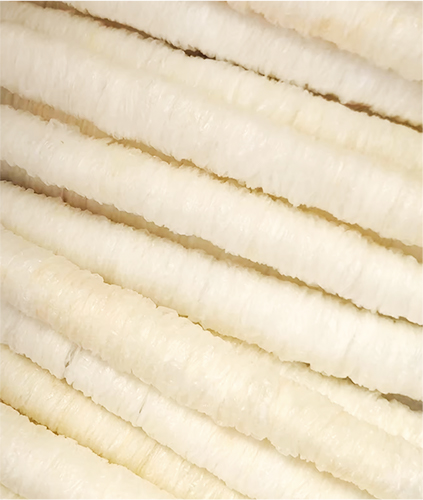
Salted natural casing rope — bundled and salt-cured for international shipping and storage.
View on supplier site →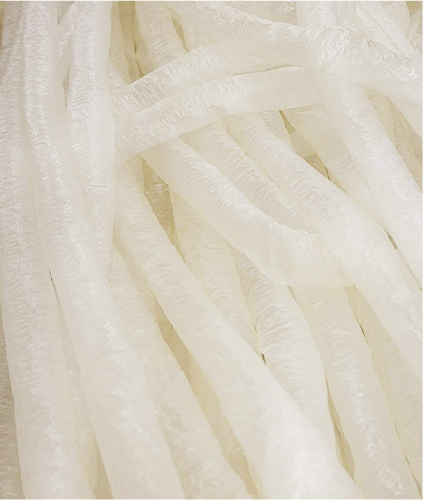
Cleaned hog/sheep natural casings — translucent, ready for processing and stuffing applications.
View on supplier site →Natural casing types and applications
| Casing type | Diameter range | Typical sausage products | Typical FOB China per 100m |
|---|---|---|---|
| Hog casing — small (28-30mm) | 28-30mm | Breakfast sausage, bratwurst, italian, kielbasa | USD 28-48 per 100m |
| Hog casing — medium (32-35mm) | 32-35mm | Bratwurst, italian sausage, polish kielbasa, chorizo | USD 35-60 per 100m |
| Hog casing — wide (36-42mm) | 36-42mm | Large bratwurst, andouille, knackwurst, smoked sausage | USD 45-78 per 100m |
| Hog casing — extra wide (42mm+) | 42-48mm+ | Large smoked sausages, mortadella precursor | USD 60-110 per 100m |
| Sheep casing — small (16-18mm) | 16-18mm | Breakfast links, frankfurters (small), wieners, vienna | USD 45-85 per 100m |
| Sheep casing — medium (20-22mm) | 20-22mm | Frankfurters (standard), bockwurst, weisswurst | USD 55-110 per 100m |
| Sheep casing — large (22-24mm+) | 22-24mm+ | Frankfurters (large), specialty thin sausages | USD 75-150 per 100m |
| Beef rounds (small intestine) | 35-50mm | Polish ring sausage, kielbasa, traditional ring sausage | USD 45-85 per 100m |
| Beef middles | 50-65mm | Salami, summer sausage, dry-cured products | USD 65-130 per 100m |
| Beef bungs (large diameter) | 80-150mm | Mortadella, large salami, capicola | USD 4.50-18.00 per piece |
| Hog bungs (cap) | 50-80mm | Capicola, traditional Italian/Spanish dry products | USD 1.80-6.50 per piece |
Quality grading and selection criteria
| Quality grade | Characteristics | Best for | Price ratio vs grade A |
|---|---|---|---|
| Grade A (premium) | Uniform diameter ±2mm; no holes; consistent length pieces 18-25m; minimal repairs | Premium dry-cured products; export to discriminating markets; restaurant butchery | 100% (baseline) |
| Grade B (standard) | Diameter ±3-4mm variation; occasional small repairs (bandage); pieces 12-18m | Standard fresh sausage production; mainstream commercial | 70-85% |
| Grade C (commercial / shorter) | Larger diameter variation; multiple repairs; shorter pieces 6-12m; some pinholes | Cost-sensitive mainstream; less-demanding sausage applications | 50-70% |
| Grade D (utility) | Significant variation; multiple repairs; short pieces; for production where casing imperfections OK | Pet food, very cost-sensitive applications | 30-50% |
Why grade matters more than price suggests
Casing quality directly affects sausage production efficiency and finished-product appearance. A Grade A casing produces 95-99% acceptable sausages with minimal stuffing problems. A Grade C casing produces 70-85% acceptable sausages — the rest fail during stuffing (burst), have visible defects (repaired sections shrinking differently), or have inconsistent appearance customers reject. The 30% price savings on Grade C is typically wiped out by the 10-25% production loss + customer complaint costs. Premium butcher operations should specify Grade A exclusively; standard commercial operations Grade B; cost-sensitive mass-market only Grade C with full understanding of trade-offs.
Salting and preservation
| Preservation method | Description | Shelf life unrefrigerated | Most common application |
|---|---|---|---|
| Dry-salted (heavy salt cure) | Casings packed in coarse salt at 35-50% by weight | 12-24 months | International export, traditional shipping |
| Salted brine (saturated salt solution) | Casings stored in saturated salt brine | 12-18 months | Wholesale distribution, retail butcher supply |
| Pre-flushed and salted | Casings flushed with water then salted; reduces preparation time at user | 9-12 months | Restaurant supply, smaller butcher operations |
| Frozen | Cleaned casings frozen at -18°C | 6-12 months at -18°C | Limited use due to texture changes; specific applications |
| Vacuum-pack salted (premium presentation) | Salt-cured + vacuum-sealed in retail-presentation packaging | 18-24 months | Retail butcher, specialty food stores |
Regulatory compliance for major export markets
| Market | Required certifications | Special considerations |
|---|---|---|
| European Union | EU establishment number; veterinary health certificate per Reg 853/2004; HACCP system; processing in approved establishment | Annual EU audits; specific traceability requirements; BSE/TSE controls |
| USA | FSIS export approval; FDA registration if applicable; HACCP plan; processing under USDA-FSIS approved program | Country of origin labeling; specific FSIS-approved establishment list |
| Australia / New Zealand | DAFF / MPI approval; veterinary certificates; BSE controls | Strict quarantine controls; specific risk assessments per source country |
| Japan | MHLW health certificate; CIQ Chinese export certificate | Detailed supplier audit; particular attention to chemical residues |
| South Korea | MFDS health certificate; veterinary export certificate | Importer registration; specific labeling |
| Middle East / Halal markets | Halal certificate (specific to processing facility); veterinary certificate | Halal applies to source animal, processing, and any contact with non-halal materials |
| Russia / EAEU | EAEU certificate; veterinary health certificate; CIQ certificate | Specific establishment approval; periodic Russian audits |
| Brazil / Latin America | MAPA certificate; varied local requirements | Tariff and import-license complexity in some markets |
Pricing brackets — wholesale
| Order tier | Total quantity | Discount | Container utilization | Lead time |
|---|---|---|---|---|
| Small butcher / specialty | 20-100 hanks (200-1,000 m) | List price; air courier or LCL | Air freight or LCL | 15-25 days |
| Mid butcher / regional distributor | 200-1,000 hanks (2,000-10,000 m) | 5-12% | LCL or partial 20' container | 20-35 days |
| Large butcher / national distributor | 2,000-10,000 hanks (20,000-100,000 m) | 12-22% | Full 20' or 40' container | 30-50 days |
| Major sausage manufacturer / industrial | 15,000+ hanks (150,000+ m) | 22-32% | 40HQ container | 45-70 days |
A 20' refrigerated container holds approximately 2,500-4,000 hanks of salted casings depending on packaging density; a 40HQ holds 5,500-9,000 hanks. Refrigerated transport (typical 0-4°C for transit) is preferred for premium casings to preserve texture and minimize salt migration; ambient transport works for standard salted casings with shorter shelf-life expectation after arrival.
Common buyer profiles
| Buyer type | Volume pattern | Quality priorities |
|---|---|---|
| Artisanal / craft butcher | Small monthly orders (10-50 hanks); variety across multiple types | Grade A only; consistent supply for product reputation |
| Restaurant supplier | Regional distributor: 200-2,000 hanks per month; broad SKU mix | Grade A-B mix; reliable delivery; competitive pricing |
| Regional butcher chain | 500-3,000 hanks per month; standardized SKUs | Grade B standard; periodic Grade A for premium products |
| National sausage manufacturer | 5,000-30,000 hanks per month; long-term contracts | Consistent Grade B/C for cost-control; documented supply chain |
| Ethnic / specialty market importer | Variable (1,000-10,000 hanks per quarter) | Specific traditional products (kosher, halal, regional traditional) |
| Pet food / animal protein processor | 10,000+ hanks per quarter; bulk grades | Lower-grade casing sufficient; cost-driven |
| Foodservice / large institutional | 5,000+ hanks annually | Predictable supply; consistent specification across product line |
Order workflow — natural casing procurement
- Application analysis — define sausage products to be produced; map each product to required casing type (hog/sheep/beef), diameter, and quality grade
- Compliance verification — verify supplier maintains current certifications for your destination market (EU establishment number, USDA-FSIS approval, etc.); request copy of current certificates with verification
- Sample order — 5-20 hanks of each candidate SKU by air freight; verify uniform diameter, no defects, salt content appropriate, casing texture and elasticity
- Production trial — run actual sausage production on samples; document stuffing pass rate (target 95%+ for Grade A), casing rupture rate, finished sausage appearance
- First wholesale order — 200-2,000 hanks for first commercial order; specify exact diameters, grade, and packaging
- Quality acceptance — incoming inspection (visual on 5-10% of hanks); document any out-of-spec product for supplier feedback
- Series replenishment — quarterly to monthly orders based on consumption; develop multi-supplier relationship (2-3 suppliers) for redundancy on critical SKUs
- Cold chain management — for refrigerated transport, ensure delivery infrastructure can maintain 0-4°C from port to your facility; for ambient transport, plan for shorter shelf-life utilization