weisourcing.com / products / China BrickMate / Concrete Brick & Block Machines

Concrete Brick & Block Making Machines from China — A Capital Equipment Buyer's Guide

A practical sourcing guide for concrete brick and block making machinery from China — written for aspiring brick plant entrepreneurs, established concrete-products manufacturers, construction-industry conglomerates, and machinery dealers in developing markets. Real product images from chinabrickmate.com covering fully automatic block machines (QT4-15 entry tier through QT15-15 premium tier), semi-automatic block machines, paving brick presses, AAC autoclaved aerated concrete production lines, mortar production equipment, mixers and material-handling, curing chamber systems, and palletizing/packaging accessories. Capacity tier selection by market analysis, multi-product capability (hollow blocks, solid bricks, paving bricks, curbstones, specialty blocks), production economics with typical ROI 14-30 months, complete production line components, AAC vs CMU selection, and the procurement workflow that establishes profitable concrete-products operations.

Manufacturer: China BrickMate (chinabrickmate.com)
Category: Industrial Machinery
Reading time: 14 min

Concrete brick and block making machinery — concrete block machines, paving brick presses, AAC autoclaved aerated concrete plants, and related material-handling equipment — are foundational capital equipment for the global construction supply chain. Every developing market needs domestic brick and block production capacity to support residential and commercial construction; established markets need replacement and upgrade equipment for existing concrete-products plants. China is the world's largest producer of concrete-block making machinery with comprehensive product range across capacity tiers and quality levels. For aspiring brick plant entrepreneurs, established concrete-products manufacturers, construction-industry conglomerates, and machinery dealers in developing markets, sourcing brick-making equipment directly from a Chinese specialist factory delivers significant cost savings vs European/American equivalents at adequate-to-excellent performance for typical applications.

This guide covers the China BrickMate product family — fully automatic block machines (QT4-15, QT8-15, QT10-15, QT12-15 capacity tiers), semi-automatic block machines for smaller operations, paving brick presses, AAC autoclaved aerated concrete production lines, mortar production equipment, mixers and material-handling, curing chamber systems, and palletizing/packaging accessories. Real product images linking back to the supplier's catalog at chinabrickmate.com.

Product range — actual catalogue images

The product images below are hosted on the manufacturer's official website (chinabrickmate.com) and link directly to the manufacturer's catalogue. Click any image to view the full specification page in a new tab.
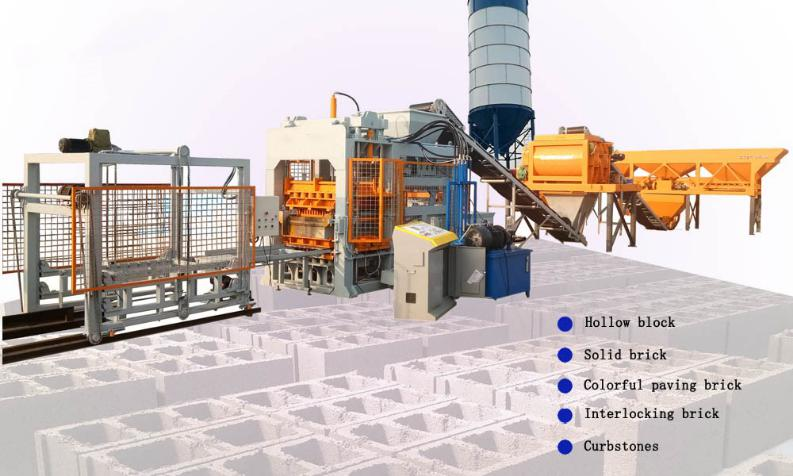
QT12-15 fully automatic concrete brick / block production line — multi-mold output, hollow blocks, solid bricks, paving bricks, interlocking bricks, curbstones.

QT12-15 fully automatic concrete brick / block production line — multi-mold output, hollow blocks, solid bricks, paving bricks, interlocking bricks, curbstones.

View on supplier site →
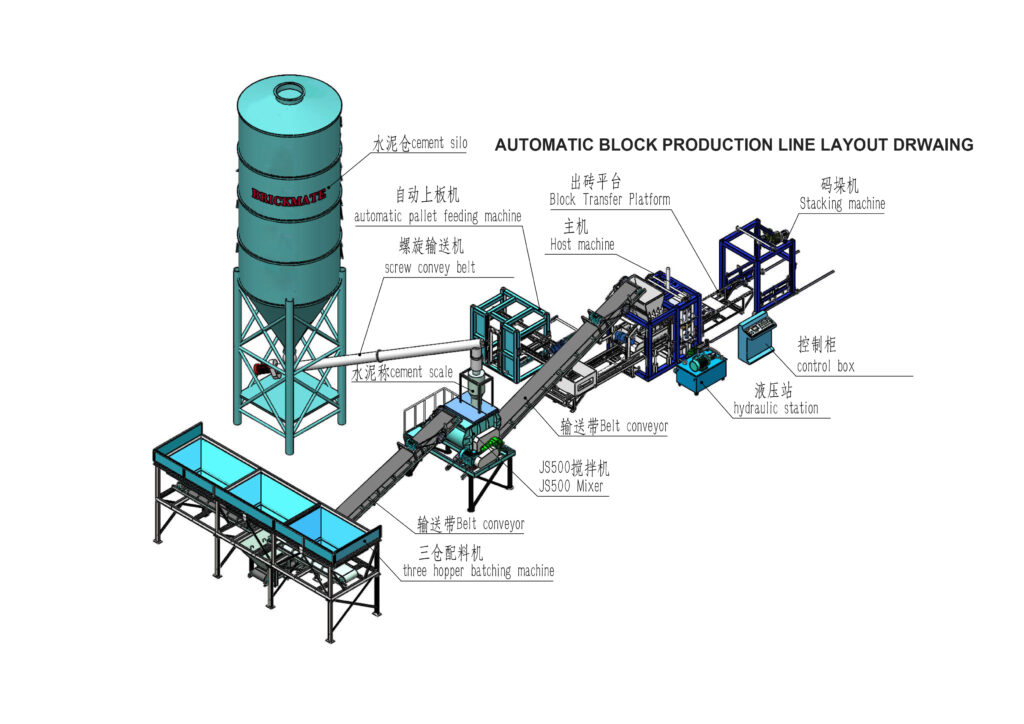
Brick production line flow chart — material handling, mixing, molding, curing, palletizing.

Brick production line flow chart — material handling, mixing, molding, curing, palletizing.

View on supplier site →

Block machine capacity tiers

ModelMold sizeHollow block output (8" / 200mm)Solid brick outputTypical FOB China price
QT4-15 (entry, small)~860 × 580mm2,400-3,200 pcs / 8hr shift4,800-6,400 pcs / 8hrUSD 14,000-22,000
QT6-15 (mid-tier)~1000 × 1000mm4,000-5,200 pcs / 8hr8,000-10,400 pcs / 8hrUSD 28,000-42,000
QT8-15 (popular tier)~1200 × 1000mm5,200-6,800 pcs / 8hr10,400-13,600 pcs / 8hrUSD 45,000-65,000
QT10-15 (large)~1400 × 1100mm6,800-8,800 pcs / 8hr13,600-17,600 pcs / 8hrUSD 75,000-110,000
QT12-15 (full automatic)~1500 × 1200mm8,800-11,200 pcs / 8hr17,600-22,400 pcs / 8hrUSD 120,000-185,000
QT15-15 (premium)~1600 × 1200mm11,200-14,400 pcs / 8hr22,400-28,800 pcs / 8hrUSD 165,000-260,000

Capacity numbers (e.g., "QT8-15") indicate two parameters: first number is mold size class (production capability) and second number is cycle time in seconds. QT4-15 means small mold class, 15-second cycle (~4 cavities per cycle). Real-world output depends on labor efficiency, raw material consistency, and shift discipline; typical 60-75% utilization vs theoretical maximum.

Product types from concrete block machines

ProductTypical dimensionsMold change timeCommon applications
Hollow block (concrete masonry unit, CMU)200 × 200 × 400mm or 150 × 200 × 400mm30-60 min mold swapLoad-bearing wall construction, infill walls
Solid concrete brick240 × 115 × 53mm or similar30-60 min mold swapLoad-bearing walls, retaining walls
Paving brick (interlocking)200 × 100 × 60-80mm various shapes30-60 min mold swapDriveways, sidewalks, plazas, public spaces
Hollow block (curtain / non-load-bearing)200 × 100 × 400mm thinner walls30-60 min mold swapInterior partitions, infill walls
Curbstone200 × 200 × 1000mm typical30-60 min mold swapRoad edge separation, landscaping
Insulating concrete (ICF) blocksCustom geometry with EPS insulation insertSpecialty moldEnergy-efficient construction
Slope blocks (interlocking landscaping)Custom geometrySpecialty moldLandscaping, retaining walls, decorative
Concrete pipe / tileVariousSpecialty mold-machine combinationDrainage, cable trough, concrete tile

Production line components and economics

ComponentFunctionTypical cost (per QT8-15 line)
Block making machine (core)Vibration molding, hydraulic pressingUSD 45,000-65,000
Aggregate batcherSand, gravel, cement weighing and feedingUSD 12,000-22,000
Concrete mixer (planetary, twin-shaft)JS750 or JS1000 mixer for fresh concreteUSD 8,000-18,000
Aggregate feeding beltConvey material from batch plant to mixerUSD 4,000-12,000
Mixer-to-machine conveyorConvey fresh concrete to molding machineUSD 3,000-8,000
Pallet supply systemAuto-feed wooden or PVC pallets to machineUSD 5,000-15,000
Curing chamber (steam or natural)Cure fresh blocks 12-48 hoursUSD 18,000-45,000 (basic) up to 80,000 (climate-controlled)
Stacker / palletizerAuto-palletize cured blocks for shippingUSD 35,000-90,000
Pallet wrapping / strappingSecure stacks for shippingUSD 5,000-12,000
TOTAL TYPICAL LINEComplete production line excluding building / civil worksUSD 130,000-250,000 (QT8-15 tier)

Production economics for block plant

Cost elementTypical figureNotes
Equipment (QT8-15 full line)USD 130,000-250,000Capital cost
Building / civil worksUSD 80,000-200,000Concrete pad, structure, drainage, electrical service
Total capital investmentUSD 210,000-450,000Excluding land
Material cost per block (8" hollow)USD 0.18-0.32Cement + aggregate + admixtures
Energy cost per blockUSD 0.02-0.05Electricity for machinery + curing
Labor cost per blockUSD 0.05-0.18Depends on country and automation level
Total cost per blockUSD 0.30-0.55Excluding capital recovery
Selling price per block (typical local market)USD 0.55-1.20Depends on market, quality, transport
Gross margin per blockUSD 0.20-0.65 (35-55% gross)Before capital recovery
ROI typical for QT8-15 line14-30 monthsDepends on market demand

Why concrete blocks remain economical

Despite the rise of alternative wall systems (steel framing, prefab panels, modular construction), concrete masonry continues to dominate residential and small-commercial construction in most developing markets and remains significant in developed markets. Drivers: (1) Local production possible — heavy aggregate is uneconomical to import, so block plants serve regional markets without competition from imports; (2) Labor-friendly construction — installation skills are widely available; (3) Cost-effective material per square meter of wall; (4) Fire-resistant and durable; (5) Acoustic / thermal performance acceptable for most applications. The production-cost differential between locally-made blocks and imported alternative wall systems typically favors blocks by 30-60% — a stable economic moat. Block plants installed in developing markets with population growth typically achieve breakeven within 12-24 months.

Pricing brackets — wholesale

Order tierEquipment scopeDiscount vs listLead time
Single machineBlock machine only; buyer sources auxiliary equipment locallyList price30-60 days
Core production packageBlock machine + mixer + batcher + main conveyors5-10%45-75 days
Complete production lineFull line including stacker, curing system, palletizer10-18%60-100 days
Multi-line / large projectMultiple production lines for larger plant15-22%90-150 days
Turnkey packageEquipment + installation supervision + training + commissioning supportCustom pricing120-180 days

Order workflow — block machine procurement

  1. Capacity analysis — define daily production target (e.g., "5,000 8-inch hollow blocks per shift"); back-calculate required machine capacity tier with 25-40% headroom
  2. Site analysis — verify available power supply (typically 50-150 kW for QT8-15 line), water supply, drainage, and structural foundations; assess raw material logistics (sand, aggregate, cement supply chain)
  3. Mold specification — define which products to produce; choose mold inventory accordingly (typically 3-6 different molds in initial set)
  4. Supplier qualification — verify supplier maintains active production with reference customers, can provide installation supervision, has spare parts supply chain
  5. Sample / inspection visit — for capital-equipment purchases, factory inspection visit recommended before order; verify production capability and quality control practices
  6. Order placement — typically 30% deposit to start production, 60-65% before shipment, 5-10% after commissioning; clear technical specification in contract
  7. Pre-shipment inspection — third-party inspection or buyer site visit to factory before shipment; verify all components match specification
  8. Installation and commissioning — supplier provides supervision (typically 7-14 days on-site); buyer provides labor for installation; commissioning includes test production with operator training
  9. Ongoing operation — spare parts inventory (10-15% of equipment cost typical first-year stocking), preventive maintenance schedule, mold inventory expansion as product line grows

China BrickMate on weisourcing.com

View the full supplier profile, certifications, contact details, and complete product catalogue.

Frequently asked questions

How do I choose between QT4-15, QT8-15, and QT12-15 capacity tiers?
Match capacity to expected market demand with growth headroom. CAPACITY DEFINITIONS: QT4-15 = small machine, ~2,400-3,200 hollow blocks per 8-hour shift; QT8-15 = popular mid-tier, ~5,200-6,800 hollow blocks per shift; QT12-15 = large fully-automatic, ~8,800-11,200 blocks per shift. SELECTION RULES: (1) FOR MARKET ASSESSMENT — determine target market block consumption: typical small town 200-500 blocks/day, medium town 500-2,000/day, large city 2,000-10,000+/day. Target market size should support ~50-70% utilization of selected machine for stable economics. (2) DEMAND GROWTH HEADROOM — typical concrete-products markets grow 5-15% annually in developing markets; size machine for current demand + 3-5 years growth, NOT just current demand. (3) LABOR AVAILABILITY — QT4 needs 4-6 workers, QT8 needs 8-12, QT12 needs 12-18; verify labor availability and cost in target market. (4) CAPITAL AVAILABILITY — QT4 line typical USD 100-200k, QT8 line USD 200-400k, QT12 line USD 350-700k including civil works; financing availability often dictates tier. PRACTICAL APPROACH: For new market entry, start with QT8-15 (popular tier) as it serves most markets adequately and has best resale value if business doesn't scale. For brownfield expansion of existing operations with proven demand, scale up to QT10-15 or QT12-15. For very small markets or pilot operations, QT4-15 is acceptable but stretch goals limited. Avoid undersizing — being capacity-constrained creates customer-service issues; oversizing creates operating-cost issues but is recoverable through downsizing operations.
What's the typical breakeven time for a concrete block plant?
Breakeven varies dramatically with market conditions but follows predictable patterns. TYPICAL BREAKEVEN for QT8-15 production line in growing market: 14-24 months from operational startup. KEY VARIABLES: (1) MARKET DEMAND vs CAPACITY — if utilization stays above 60%, breakeven 12-18 months; if 40-60%, 18-30 months; below 40%, plant struggles to reach breakeven. (2) MATERIAL COST EFFICIENCY — cement is dominant cost; access to bulk cement at competitive prices vs bag cement makes 15-25% cost difference. (3) LABOR COST — local labor cost varies hugely; high-labor-cost markets need higher automation. (4) PRICING POWER — well-positioned plants in undersupplied markets can charge premium 15-25% over commodity blocks; commoditized markets force pricing to material cost + 25-35% margin. (5) ENERGY COST — electricity is 8-15% of total cost; grid-stable markets with reasonable rates favor; unstable grid forces backup generators and reduces margin. SUCCESS PATTERNS: (1) UNDERSERVED MARKETS — entering market where existing block plants are running at full capacity (visible by long lead times and price premiums); (2) GOVERNMENT INFRASTRUCTURE PROJECTS — committing significant volume creates predictable demand; (3) DEVELOPER PARTNERSHIPS — exclusive supply to specific real estate developers for predictable volume; (4) GEOGRAPHIC POSITIONING — plant within 50km of construction sites (heavy aggregate makes longer transport uneconomical); (5) PRODUCT MIX — combining standard hollow blocks with paving bricks adds revenue per machine investment. FAILURE PATTERNS: oversupplied markets, wrong machine size for demand, weak management of cement procurement, poor receivables management.
How does the AAC (autoclaved aerated concrete) line compare to traditional block machine?
AAC and traditional concrete blocks are complementary not competitive products. AAC PROPERTIES: lightweight (about 1/3 the density of solid concrete), excellent thermal insulation (R-value 1.0-2.0 per inch vs 0.05-0.15 for concrete block), excellent acoustic insulation, fire-resistant, easily machined with hand tools. AAC PRODUCTION: complete process from quartz sand + cement + lime + aluminum powder + water → mixing → casting → autoclaving (high-pressure steam at 180-200°C for 8-12 hours). Equipment cost is significantly higher than CMU lines. Typical AAC plant: USD 1.5-5 million for 50,000-200,000 m³/year capacity. AAC APPLICATIONS: high-rise residential (lightweight reduces structural cost), thermal-performance-critical buildings, fast-construction projects (lightweight enables manual installation), hot/cold climate buildings where insulation matters. AAC PRICING: typically 2-3x retail price per cubic meter of solid concrete block; energy savings over building lifetime offsetting higher unit cost. CONCRETE BLOCK PROPERTIES: heavy, lower thermal/acoustic performance but cheaper, well-suited to load-bearing walls in moderate climates. SELECTION RULES: (1) Hot/cold climate residential → AAC saves operating energy; (2) Tropical/temperate residential → traditional CMU adequate; (3) Industrial / commercial → traditional CMU dominant; (4) High-rise residential where structural weight matters → AAC; (5) Roads, retaining walls, infrastructure → CMU only. INVESTMENT LOGIC: AAC plants in markets with energy-cost-driven demand can be very profitable; AAC plants in low-energy-cost markets struggle to justify premium price. China BrickMate offers both CMU equipment and AAC plants — selection depends on market analysis.
What's involved in commissioning a block machine — how long until production?
Commissioning is a structured 2-4 week process from equipment arrival to commercial production. WEEK 1 — INSTALLATION: (1) Foundation prep complete before equipment arrival; (2) Equipment arrives at port, customs clearance, transportation to site (5-15 days from port); (3) Equipment offloading and positioning (2-3 days); (4) Mechanical assembly per supplier instructions (3-5 days); (5) Electrical connection per local electrical code (2-4 days); (6) Hydraulic system pressurization and test (1-2 days). WEEK 2 — SUPPLIER COMMISSIONING: (1) Supplier engineer arrives at site (typical scope: 7-14 days included with equipment purchase); (2) System checkout — verify all components functional, leak test, sensor calibration; (3) First wet test runs — produce a few sample blocks; (4) Mold installation, alignment, troubleshoot any tolerance issues. WEEK 3 — PRODUCTION TRIAL: (1) Material qualification — verify local sand, aggregate, cement produces good blocks (often requires mix design adjustment); (2) Cycle time optimization — tune machine for local materials and target output; (3) Operator training — typically 1-2 weeks for local crew to become productive. WEEK 4 — RAMP-UP: (1) Full-shift production trials; (2) Quality testing of finished blocks (compressive strength, dimensional accuracy, visual quality); (3) Process documentation and standard operating procedures. TOTAL TIME from equipment arrival to commercial production: 25-45 days typical. RAMP-UP TIME from commercial start to full capacity utilization: 30-90 days additional, as crew skills mature and supply chains stabilize. SUCCESS FACTORS: (1) Civil works completed BEFORE equipment arrival (delays are common but expensive); (2) Local mix design proven before equipment arrival (sand/aggregate quality matters); (3) Cement supply secured at start of operations; (4) Spare parts inventory of 10-15% of equipment value on-site by start.
How do I source spare parts and maintain a Chinese block machine?
Spare parts and maintenance is a critical ongoing cost — plan for it. SPARE PARTS INVENTORY at start of operations: (1) WEAR PARTS — hydraulic seals, bearings, mold consumables, vibration dampers; budget 5-8% of equipment cost as initial spares; (2) CRITICAL FAILURE PARTS — hydraulic valves, sensors, control modules; budget 3-5% of equipment cost; (3) MOLD INVENTORY — additional molds for product mix expansion; varies with product strategy. ONGOING PARTS SOURCING: (1) Original supplier provides best fit and warranty support; typical spare parts ship 2-4 weeks from China by air for urgent items, 6-10 weeks by sea for routine; (2) After 5-10 years, supplier model may be discontinued — important to maintain mechanical drawings and key dimensions for fabrication. PREVENTIVE MAINTENANCE: (1) DAILY — visual inspection, leak check, cleaning; (2) WEEKLY — lubrication of grease points, hydraulic oil check; (3) MONTHLY — full hydraulic oil analysis, sensor calibration check; (4) QUARTERLY — major hydraulic seal replacements, electrical contact cleaning; (5) ANNUALLY — major overhaul, hydraulic oil change, mold inspection and refurbishment. MAINTENANCE COST: typical 8-15% of revenue for well-run plant; includes parts, fuel/electricity for generators, labor for maintenance crew. EQUIPMENT LIFE: well-maintained Chinese block machines achieve 10-20 year service life; major overhaul typically required at 5-7 years (hydraulic system) and 10-15 years (mechanical components). RESALE VALUE: well-maintained Chinese block machine retains 25-50% of original value after 5 years; specific markets like Africa/Latin America often have ready secondary markets for these machines.
Can I produce paving bricks and curbstones on the same machine as hollow blocks?
Yes — multi-product capability is a major advantage of modern block machines. STANDARD MULTI-PRODUCT CAPABILITY: most QT-series machines support 5-15 different products via mold changes. Common product mix: (1) HOLLOW BLOCKS — 4 different cavity sizes (8 inch, 6 inch, 4 inch, half-height) covers 60-70% of typical wall construction needs; (2) SOLID BRICKS — 1-2 standard brick sizes for retaining walls, pavers, traditional masonry; (3) PAVING BRICKS — 3-6 different shapes (rectangular, herringbone, hexagon, octagonal, etc.) for exterior applications; (4) CURBSTONES — 1-2 sizes for road edge separation; (5) SPECIALTY — slope blocks, decorative blocks. MOLD CHANGE TIME: typically 30-60 minutes per change (varies with operator skill). Plan production runs of 4-12 hours per product to minimize mold change frequency. PRODUCTION SCHEDULING: typical block plant runs 1-3 product changes per shift; some run extended single-product runs (full week of hollow blocks, then full week of paving) for efficiency. PRODUCT MARGIN OPTIMIZATION: hollow blocks are commodity (lower margin per block but high volume); paving bricks are premium (higher margin per block but lower volume); curbstones are stable demand (specialized supply). Multi-product strategy: 70-80% capacity on commodity hollow blocks, 15-25% on premium paving bricks, 5-10% on specialty/curbstone for revenue diversification. MOLD INVENTORY: budget 3-8 different molds initial set (USD 1,500-8,000 per mold), expand mold library as market demand evolves. Mold lifespan typical 200,000-500,000 cycles; replace when wear affects block quality.
⚠ Important Disclaimer

Source: Product images on this page are hosted on the manufacturer's official website (chinabrickmate.com) and link directly back to that website. All product information was summarised from the supplier's public catalogue.

Brand mentions and trademark compliance: References to Tier-1 block machine manufacturer brands (Masa, Zenith, Besser, Columbia Machine, Hess, Tiger Stone) are made for the sole purpose of describing functional benchmarks and supply-chain context. China BrickMate is not authorized by, affiliated with, or endorsed by any of these brand owners. Products are aftermarket-fit cross-reference equipment manufactured under China BrickMate's own brand or buyer-private-label only.

Capital equipment risk: Block machine purchase is a major capital deployment. Buyers should conduct comprehensive supplier qualification (factory audit, reference customers, financial stability check), verify equipment specifications match contract, and engage qualified technical support for installation and commissioning. Improperly specified or installed equipment can cause major operational issues affecting business viability.

Site and infrastructure responsibility: Block plant operation requires adequate power supply, water, drainage, raw material supply chain, and trained labor. Site analysis and capability verification should occur BEFORE equipment order. Most equipment problems trace back to site/infrastructure issues rather than equipment quality.

Pricing & specifications: All price ranges, capacity figures, and ROI estimates reflect general market observation and may not apply to specific projects. Real-world plant economics depend significantly on market demand, cement and aggregate pricing, energy cost, labor cost, and operational management. Confirm current pricing, MOQ, lead time, technical specifications, and commissioning support directly with the supplier.

No middleman role: Weisourcing provides supplier discovery and editorial content. All transactions occur directly between buyer and supplier through the contact channels published on the supplier's official website.