weisourcing.com / products / Alubond / Aluminum Composite Panels (ACM)

Aluminum Composite Panels (ACM) from China — A Wholesale Buyer's Guide for Architectural Cladding

A practical sourcing guide for aluminum composite panels (ACM / ACP) from China — written for architectural cladding contractors, facade engineering firms, building product distributors, and large-project owners. Real product images from alubond.uk covering A2 fire-rated panels (mineral core, EN 13501-1 Class A2-s1,d0 per post-Grenfell building codes), FR B-class fire-retardant panels (~70% mineral filler), standard PE-core panels (where allowed by code), copper-faced and stainless-steel-faced premium variants, zinc-titanium-faced for European architectural style, mirror polished and brushed finishes, and wood-grain decorative finishes. Coating systems (polyester through premium PVDF / FEVE / anodized), specifications and physical properties, container utilization for project planning, fire-rating verification protocols, certifications (EN 13501-1, BS 8414, ASTM E84/NFPA 285, AS 5113, AAMA 2605, CE marking), and the procurement workflow that delivers cost-effective ACM for commercial cladding projects.

Manufacturer: Alubond (alubond.uk)
Category: Building Materials & Construction
Reading time: 14 min

Aluminum composite panels (ACM, ACP) are the dominant facade material for modern commercial architecture — high-rise office buildings, shopping centers, hotels, hospitals, sports venues, transportation hubs, and high-end residential projects worldwide. The construction is two thin aluminum face sheets bonded to a polyethylene or fire-resistant mineral core, producing rigid panels with the appearance and weather-resistance of solid aluminum at significantly lower weight and cost. Following several high-profile fire incidents (Grenfell Tower 2017), the industry has shifted decisively toward A2 fire-rated panels with mineral cores. China is the world's largest ACM producer, with global market share roughly 60-70%. For architectural cladding contractors, facade engineering firms, building product distributors, and large-project owners, sourcing ACM panels directly from a Chinese specialist factory delivers significant cost savings vs European/Korean equivalents at comparable performance — provided fire rating is correctly specified and verified.

This guide covers the Alubond product family — A2 fire-rated panels (mineral core, EN 13501-1 Class A2-s1,d0), B-class fire-retardant panels, standard PE-core panels (where allowed by code), copper-faced and stainless-faced premium variants, anodized and PVDF-coated finishes, and curved/perforated specialty applications. Real product images linking back to the supplier's catalog at alubond.uk.

Product range — actual catalogue images

The product images below are hosted on the manufacturer's official website (alubond.uk) and link directly to the manufacturer's catalogue. Click any image to view the full specification page in a new tab.
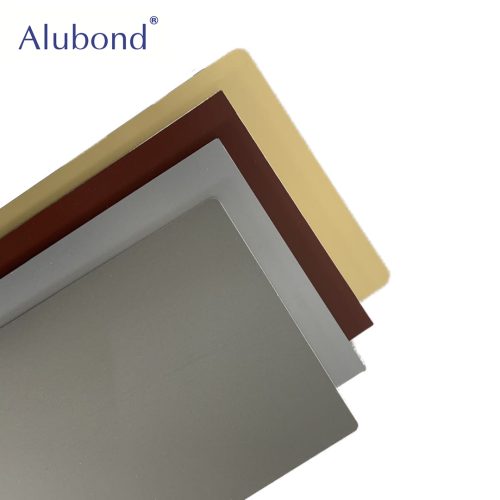
A2 fire-rated aluminum composite panel — non-combustible mineral core with aluminum facing.

A2 fire-rated aluminum composite panel — non-combustible mineral core with aluminum facing.

View on supplier site →
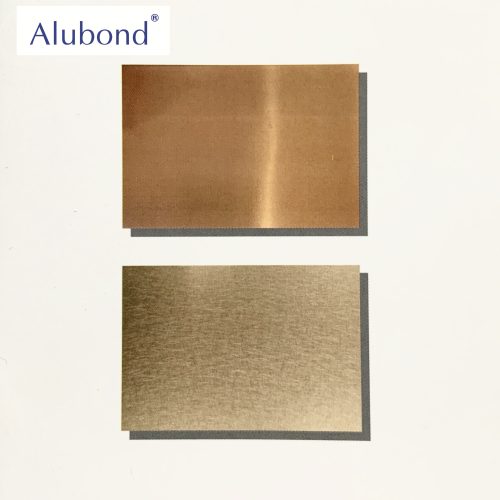
Copper-aluminum composite panel — premium architectural cladding with copper face.

Copper-aluminum composite panel — premium architectural cladding with copper face.

View on supplier site →
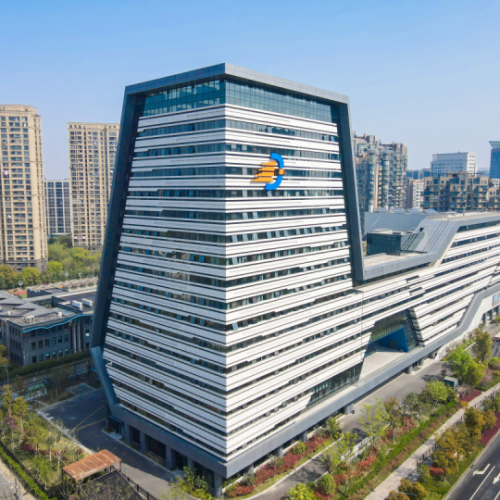
Hangzhou Sports Center facade — large-scale ACM application showing curved-panel architecture.

Hangzhou Sports Center facade — large-scale ACM application showing curved-panel architecture.

View on supplier site →

ACM panel categories by fire rating

Panel typeCore materialFire rating (EN 13501-1)Best applicationsFOB China typical price
A2 fire-rated≥90% mineral filler in polymer matrixA2-s1,d0 (non-combustible)High-rise residential, hospitals, schools, public buildings (regulated jurisdictions)USD 24-42 per m² (4mm thick)
FR (fire-retardant) B-class~70% mineral filler in PE matrixB-s1,d0 (limited combustibility)Mid-rise commercial, where A2 not mandated by codeUSD 16-28 per m²
Standard PE corePolyethyleneE or unrated (combustible)Low-rise commercial, signage (where allowed by code)USD 9-18 per m²
Copper-faced ACMA2 mineral or PEPer core selectedPremium architectural, high-end commercialUSD 65-180 per m²
Stainless-steel-faced ACMA2 mineral or PEPer core selectedMarine, premium commercial, durability-criticalUSD 55-145 per m²
Zinc-titanium-faced ACMA2 mineralA2-s1,d0Premium European architectural styleUSD 45-95 per m²
Mirror polished aluminum-facedPE or A2Per coreDecorative interiors, signage, retailUSD 14-32 per m²
Wood-grain finishPE or FR (B-class)Per coreDecorative facades, signageUSD 14-26 per m²

Fire rating specification is critical — Grenfell-class liability

The 2017 Grenfell Tower fire (London) was caused in significant part by ACM panels with combustible PE core that propagated fire up the building exterior. Following Grenfell: (1) UK ACM regulations now restrict combustible ACM on buildings >18m height and on relevant buildings >11m; (2) EU member states have adopted similar restrictions; (3) Australia has restricted combustible ACM nationwide; (4) UAE and Middle East have updated codes; (5) USA codes require non-combustible ACM on Type I-IV construction.

For any commercial or multi-occupancy building, specify A2-s1,d0 fire-rated panels per EN 13501-1 (or equivalent destination-market non-combustibility standard). Verify supplier provides current fire test certificates from accredited test labs (TÜV, BRE, BSI, IBMB, etc.) for the specific product variant supplied. Counterfeit fire test certificates are a known industry problem — verify with issuing certification body if uncertain. Selling combustible ACM into restricted applications creates major liability exposure including criminal charges in UK following Grenfell. Working with reputable suppliers like Alubond who maintain documented fire-rating certification protects against these risks.

Specifications and physical properties

SpecificationStandard 4mm A2 panelStandard 4mm PE panel
Total thickness4mm (3mm and 6mm available)4mm (3mm and 6mm available)
Aluminum face thickness0.3-0.5mm each side0.3-0.5mm each side
Standard panel size1220 × 2440mm or 1500 × 3000mm typicalSame
Maximum custom size1500 × 8000mm typicalSame
Weight per m²~7.5 kg/m² for 4mm A2~5.5 kg/m² for 4mm PE
Tensile strength~100 MPa~110 MPa
Flexural rigidity (EI/m)0.45 kN·m²/m0.45 kN·m²/m
Thermal expansion2.4 × 10⁻⁵ /K2.4 × 10⁻⁵ /K
Sound transmission loss~26 dB at 4mm~26 dB at 4mm
Maximum service temperature~80°C continuous~80°C continuous

Coating systems and durability

CoatingPropertiesWarrantyBest applications
PE (polyester) coatingLow-cost, indoor or short-life outdoor5-7 yearsInterior, signage, low-budget commercial
HDP (high-durability polyester)Improved UV resistance vs PE10-15 yearsMid-tier commercial outdoor
PVDF (Kynar 500 / Hylar 5000 type)Premium outdoor durability, color stability15-25 yearsPremium architectural, high-rise commercial
FEVE (fluoroethylene vinyl ether)Even more durable than PVDF20-30 yearsHighest-tier premium architectural
Anodized aluminumNaturally durable; metallic appearance20+ years (color-stable)Premium European architectural style
Mirror polishedDecorative finish; less durable in dirty environments3-5 years gloss retentionInterior decorative, retail signage
Brush finishDecorative finish; hide minor scratches10-15 yearsArchitectural feature, retail facade
Wood grain printDecorative; PVDF top-coat for durability10-20 years depending on top-coatDecorative facade, hospitality, retail

Pricing brackets — wholesale

Order tierTotal quantityDiscountContainer utilizationLead time
Small project / contractor500-3,000 m² totalList priceLCL or partial 20' container25-40 days
Mid project / regional contractor5,000-25,000 m²5-12%Full 20' or 40' container30-50 days
Large commercial project30,000-100,000 m²12-22%Multiple 40HQ containers40-65 days
Major architectural project / national distributor200,000+ m²20-30%Bulk vessel or multiple containers50-100 days

Container utilization: a 40HQ container holds approximately 800-1,200 panels (1500×3000mm) packed flat with cardboard separators, ~3,600-5,400 m² total area. For a typical 30,000 m² commercial facade, plan 7-9 containers across staggered shipments to support installation schedule.

Compliance and certification

StandardApplies toMarkets where critical
EN 13501-1Reaction to fire classification (A1, A2, B, C, D, E, F)EU + most international markets
BS 8414Large-scale fire test for cladding systems (UK)UK after Grenfell
ASTM E84 / NFPA 285Surface burning characteristics + multistory test (US)USA building code
AS 5113Fire propagation testing (Australia)Australia
EN 1090Execution of steel and aluminum structures (CE marking)EU structural cladding
ASTM E330Wind load resistance (US)US building code
ASTM E283 / E331Air infiltration / water penetrationUS weatherproofing
QUALICOAT / GSBCoating quality certificationPremium European architectural
AAMA 2605Premium PVDF coating performance (US)USA premium architectural
CE markingConstruction Products Regulation 305/2011 (EU)EU building products

Order workflow — ACM panel procurement

  1. Project specification analysis — review architect drawings for panel quantity, dimensions, finishes, fire rating requirement, and installation system; verify destination-market fire code compliance
  2. Fire rating verification — request supplier's current EN 13501-1 (A2-s1,d0) test certificate from accredited test lab; verify expiration date; check certificate matches specific product variant; for UK projects also BS 8414 test data
  3. Sample order — typically 5-15 m² of each candidate finish; verify color match against project Pantone/RAL specification, surface quality, edge finish, panel flatness; document any color or texture variations
  4. Color/finish approval — architect/designer reviews physical samples and approves; supplier produces production based on approved samples; color tolerance typically ΔE ≤ 1.0 for premium, ≤ 2.0 for standard
  5. Pre-production planning — confirm panel sizes, edge profiles (square cut vs grooved for cassette systems), packaging (vertical or horizontal), labeling per project zones, shipping schedule aligned with installation
  6. Production and quality acceptance — pre-shipment inspection (panel flatness, color uniformity, fire rating compliance with mill cert per batch); spot-check 2-5% of panels in receiving
  7. Site delivery and installation — staggered shipments aligned with installation crew schedule; on-site QC for damage during shipping; document any defects for replacement
  8. Installation system compatibility — coordinate with cladding contractor on panel-to-cassette compatibility; some panels designed for specific Tray, Hook, or Z-fix systems — incompatibility creates installation problems

Alubond on weisourcing.com

View the full supplier profile, certifications, contact details, and complete product catalogue.

Frequently asked questions

What's the difference between A2 fire-rated and PE-core ACM panels?
Fundamental difference in fire performance with major code implications. PE-CORE PANELS — polyethylene core (~99% PE plastic). Properties: lower cost, lighter weight, easier to bend/process. Fire performance: combustible (Class E or F per EN 13501-1); will burn vigorously when ignited; flame spreads rapidly along panel surface. POST-GRENFELL CODE STATUS: PE-core panels are RESTRICTED OR PROHIBITED on most commercial and multi-occupancy buildings in UK (>11m or >18m depending on building type), EU member states (varying by country), Australia (effectively banned for residential and high-rise commercial), UAE, and US (Type I-IV construction). PE-core remains acceptable for: (1) Low-rise commercial in many jurisdictions; (2) Signage; (3) Interior signage and decorative; (4) Detached residential. A2 FIRE-RATED PANELS — ≥90% mineral filler in polymer matrix. Properties: higher cost (~50-80% premium over PE), heavier weight (35-40% heavier), slightly less easy to bend. Fire performance: Class A2-s1,d0 per EN 13501-1 (non-combustible, no smoke, no flaming droplets); does not contribute to fire spread. POST-GRENFELL CODE STATUS: required on most commercial buildings >11m, all high-rise residential, hospitals, schools, public buildings. SELECTION RULE: for any commercial building where fire code applies, default to A2; for low-rise non-regulated applications (signage, low-rise decorative), PE-core is acceptable cost saving. The cost premium for A2 (~50-80%) is dwarfed by liability exposure for non-compliant cladding installation in regulated buildings.
How do I verify a fire-rating certificate is genuine?
Counterfeit fire test certificates are a known industry problem post-Grenfell. VERIFICATION STEPS: (1) CHECK ISSUING TEST LAB — accredited labs in major markets include TÜV (Germany), BRE (UK), BSI (UK), IBMB (Germany), Warrington Fire (UK), Southwest Research Institute (US), CSIRO (Australia). (2) CONTACT ISSUING LAB DIRECTLY — call the test lab to verify certificate exists in their records; lab will typically confirm if you provide certificate number. (3) MATCH PRODUCT TO TEST — verify the certificate matches the specific product variant being supplied (different fire ratings for different core compositions; one A2 cert doesn't cover other core types). (4) CHECK EXPIRATION — fire test certificates have validity periods (typically 5 years) and must be renewed; expired certificates are not valid for current production. (5) VERIFY BATCH/PRODUCTION CONNECTION — premium suppliers maintain ongoing production audit by certification body; ask for current factory audit reports. RED FLAGS: (a) Certificate doesn't list specific product variant; (b) Certificate is from unknown or unaccredited test lab; (c) Supplier won't provide direct contact at issuing lab; (d) Certificate language doesn't match standard format for that lab; (e) Test report missing technical details that should be present (raw test data, sample preparation method). PROCUREMENT BEST PRACTICE: for any building where fire code applies, request test certificate at order time, verify with issuing lab before commitment, retain copy in project records for occupancy approval. Reputable suppliers like Alubond maintain transparent fire-rating documentation with verifiable test results.
What's the difference between PVDF and polyester (PE) coating, and when do I need each?
Two main coating chemistries with very different durability. POLYESTER (PE) COATING — basic polyester resin with pigment, baked finish. Properties: low cost, adequate UV resistance for short-term outdoor, color holds 5-7 years before noticeable fading, gloss retention 5 years typical. Best for: interior applications, signage, low-budget commercial outdoor, short-life-cycle projects. HDP (HIGH-DURABILITY POLYESTER) — improved polyester with UV stabilizers. Properties: 10-15 year color and gloss retention, intermediate cost. Best for: mid-tier commercial outdoor where premium cost not justified. PVDF (POLYVINYLIDENE FLUORIDE, brand names Kynar 500 / Hylar 5000) — fluoropolymer-based premium coating. Properties: 15-25 year color stability, excellent UV resistance, chalk-resistant, color-stable through aging, premium architectural standard. Best for: high-rise commercial, premium architectural, projects with 20+ year design life expectations. Cost premium 30-50% over polyester. FEVE (FLUOROETHYLENE VINYL ETHER) — newer generation premium fluoropolymer. Properties: 20-30 year durability, even more color-stable than PVDF. Best for: highest-tier architectural projects. Cost premium 50-80% over polyester. SELECTION RULES: (1) For premium architectural with 20+ year design life: PVDF or FEVE; (2) For mid-tier commercial: HDP adequate; (3) For interior or signage: polyester acceptable; (4) For coastal/marine projects, regardless of cost tier, PVDF minimum due to salt-spray exposure. Premium PVDF coating typically warranted 15-20 years color/gloss retention by reputable manufacturers; polyester typically 5-10 years.
What's the typical delivery and installation timeline for an ACM project?
ACM cladding sits in critical path for commercial construction project schedules. PROJECT TIMELINE for typical 20,000 m² commercial cladding: (1) DESIGN AND APPROVAL: 4-12 weeks for architect specification, fire engineering review, cladding system selection. (2) PROCUREMENT INITIATION: 2-4 weeks for supplier qualification, pricing, contract execution. (3) PANEL SAMPLES AND APPROVAL: 3-6 weeks for sample production, color matching, architect approval, finalized order specification. (4) PANEL PRODUCTION: 30-60 days for first batch; subsequent batches 20-40 days; full project supply typically 60-120 days from order placement. (5) SHIPPING: 25-45 days sea freight from China to most destinations; air freight 4-7 days for emergency / small quantity. (6) INSTALLATION: 1-3 m² per worker per day for cassette systems, 2-5 m² per worker per day for traditional rivet attachment; 20,000 m² project typically 4-8 weeks installation crew time. (7) HANDOVER: defects punch-list, replacement panels, final inspection 1-3 weeks. TOTAL PROJECT TIMELINE: 7-12 months from architect specification to handover. CRITICAL PATH MANAGEMENT: ACM is often critical path for facade closure (which controls interior fitout and HVAC commissioning). Late ACM delivery delays entire project. RISK MITIGATION: (1) Order 80-90% of project panels in first batch with 10-20% reserved for late additions/replacements; (2) Multiple shipments to spread risk and align with installation crew capacity; (3) Pre-production shop drawings approved before main production starts; (4) For large projects, 2-3 supplier qualification with primary at 70%, secondary at 30% to reduce single-supplier risk.
How does Chinese ACM compare to European brands like Reynobond, Alucobond, Trespa?
For mainstream ACM applications, premium-tier Chinese manufacturers like Alubond deliver products at quality close to Tier-1 European brands at meaningfully lower cost. The performance parity is achievable because: (1) MANUFACTURING TECHNOLOGY — modern continuous-line ACM lamination is mature; the same German / Italian / Korean equipment is used by Chinese, European, and Korean factories; (2) RAW MATERIALS — aluminum sheet from same global suppliers; coating chemicals (PVDF, polyester) from same chemical companies (PPG, Beckers, Akzo Nobel, Valspar); (3) FIRE TESTING — Chinese factories test in same accredited labs (TÜV Germany, BRE UK, etc.) as European competitors. WHERE TIER-1 BRANDS RETAIN ADVANTAGE: (1) BRAND-DRIVEN PROJECTS — premium architectural projects often spec Reynobond / Alucobond by name for design liability protection; (2) PROPRIETARY FIRE-RATING TECHNOLOGY — some patented formulations have specific large-scale test (BS 8414) approvals not yet matched; (3) COLOR PALETTE — Tier-1 maintains library of 100+ standard colors with multi-decade consistency; (4) WARRANTY ENFORCEMENT — Tier-1 has long-established warranty handling vs newer Chinese suppliers. FOR MAINSTREAM USE (commercial cladding, mid-tier architectural projects, retrofit), premium Chinese ACM at 50-65% of Tier-1 retail delivers fully-equivalent performance. PROCUREMENT STRATEGY: for highest-tier landmark projects with brand-required spec, use Tier-1; for mainstream commercial / retrofit / mid-tier residential, qualified Chinese supplier delivers cost savings without quality compromise. Quality verification matters more than brand choice — verify fire ratings, coating warranty, factory audits regardless of supplier choice.
What installation systems are compatible with Chinese ACM panels?
ACM installation systems are largely standardized but with regional variations. CASSETTE SYSTEMS — panel pre-formed at factory into rigid cassette with hooked edges; cassettes hang on aluminum sub-frame attached to building. Properties: clean exterior appearance with no visible fasteners, easy installation, easy panel replacement. Best for: high-rise commercial, premium architectural. Compatible with most Chinese ACM panels. Z-FIX / TRAY SYSTEMS — panel formed into shallow tray and hooked onto aluminum extrusion. Properties: lower cost than full cassette, decent appearance, decent rain-screen ventilation. Compatible with most Chinese ACM. RIVET FIX (TRADITIONAL) — panel attached directly to sub-frame with face rivets. Properties: lowest cost, fastener heads visible (color-matched), simple installation, less weather-tight than cassette. Best for: budget commercial, signage. Compatible with all ACM. STRUCTURAL SILICONE GLAZING (SSG) — panel attached with structural silicone adhesive (no visible fasteners). Properties: premium appearance, requires specialized installation, weather-tight. Compatible with ACM that has appropriate edge profile. POINT-FIXED SYSTEMS — panel attached at specific points with concealed brackets. Properties: premium appearance, complex engineering. Used for high-end architectural. CHINESE ACM COMPATIBILITY: most reputable Chinese suppliers can produce panels with edge profiles matching all major installation systems — square cut, beveled edge, grooved for cassette, formed cassette panels. Specify installation system at order time so panels match. For specialized systems (ASTC ProTech, Trespa Pura, Equitone Linea), verify panel-to-system compatibility before commitment. Cassette systems represent ~60% of premium architectural cladding; rivet fix ~25% of budget commercial; remaining 15% specialized/SSG/point-fixed.
⚠ Important Disclaimer

Source: Product images on this page are hosted on the manufacturer's official website (alubond.uk) and link directly back to that website. All product information was summarised from the supplier's public catalogue.

Brand mentions and trademark compliance: References to Tier-1 ACM manufacturer brands (Arconic Reynobond, 3A Composites Alucobond, Trespa, Alpolic Mitsubishi Plastics, Kynar 500, Hylar 5000) are made for the sole purpose of describing functional benchmarks and supply-chain context. Alubond is not authorized by, affiliated with, or endorsed by any of these brand owners. Products are aftermarket-fit cross-reference materials manufactured under Alubond's own brand or buyer-private-label only.

Fire safety responsibility: ACM panels in commercial buildings, multi-occupancy buildings, and high-rise structures must meet destination-jurisdiction fire codes. Following Grenfell Tower fire (2017), regulations have tightened significantly in UK, EU, Australia, UAE, and US. Specifying combustible PE-core ACM in restricted applications creates major liability exposure including criminal charges in UK. Verify all fire-rating certifications are current with future audit dates and that specific product variant is in certificate scope.

Building code compliance: ACM cladding installation must comply with all applicable building codes including fire safety, structural wind load (ASTM E330 / EN 1991-1-4), weathertightness, and thermal performance. Local building permit and inspection process must be followed. Working with experienced facade engineering and qualified cladding contractors is essential for code-compliant installation.

Pricing & specifications: All price ranges, fire-rating designations, and tier definitions reflect general market observation. Real-world ACM performance depends on installation system quality, sub-frame design, and maintenance. Confirm current pricing, MOQ, lead time, and material certifications directly with the supplier.

No middleman role: Weisourcing provides supplier discovery and editorial content. All transactions occur directly between buyer and supplier through the contact channels published on the supplier's official website.