weisourcing.com / products / Bioleaderpack / Biodegradable Foodservice Packaging

Biodegradable & Compostable Foodservice Packaging from China — A Wholesale Buyer's Guide

A practical sourcing guide for biodegradable and compostable foodservice packaging from China — written for foodservice distributors, restaurant chains, hospitality buyers, hospital and institutional foodservice operators, event caterers, and brand programs replacing single-use plastic with certified compostable alternatives. Real product images from bioleaderpack.com covering sugarcane bagasse clamshells, bowls, plates, takeout containers, hot and cold cups, lids, cutlery, plus PLA-coated paper alternatives. Material types (bagasse, bamboo, wheat straw, PLA, CPLA, PLA-coated paper, kraft, PHA), product pricing across 15+ category breakdowns, compliance certifications by destination market (BPI, EN 13432, OK Compost, AS 4736, PFAS-free), and the procurement workflow for foodservice operators transitioning from plastic to compostable.

Manufacturer: Bioleaderpack (bioleaderpack.com)
Category: Packaging & Printing
Reading time: 14 min

Single-use plastic foodservice packaging — clamshell takeout containers, hot/cold cups, plates, bowls, cutlery — is being banned, restricted, or taxed in dozens of jurisdictions worldwide. The EU's SUP Directive (effective 2021), bans on expanded polystyrene foam in 12+ US states, plastic-bag-and-cutlery levies in the UK, France, and most of Latin America, and increasingly aggressive sustainability commitments from major foodservice chains have created a multi-billion-dollar replacement market for compostable, biodegradable, plant-fiber alternatives. Sugarcane bagasse (the fibrous byproduct of sugar production), bamboo fiber, wheat straw, and PLA-coated paper have become dominant replacement materials. China is the dominant global producer, with specialist factories converting agricultural-byproduct fiber into shaped foodservice packaging at industrial scale.

This guide covers the Bioleaderpack product family — sugarcane bagasse clamshells, bowls, plates, takeout containers, hot cups, cold cups, lids, cutlery, plus PLA-coated paper alternatives, kraft paper foodservice items, and CPLA / PLA cutlery. Real product images linking back to the supplier's catalog at bioleaderpack.com.

Product range — actual catalogue images

The product images below are hosted on the manufacturer's official website (bioleaderpack.com) and link directly to the manufacturer's catalogue. Click any image to view the full specification page in a new tab.

Bagasse foodservice packaging family — clamshells, bowls, plates, lids in molded sugarcane fiber.

Bagasse foodservice packaging family — clamshells, bowls, plates, lids in molded sugarcane fiber.

View on supplier site →
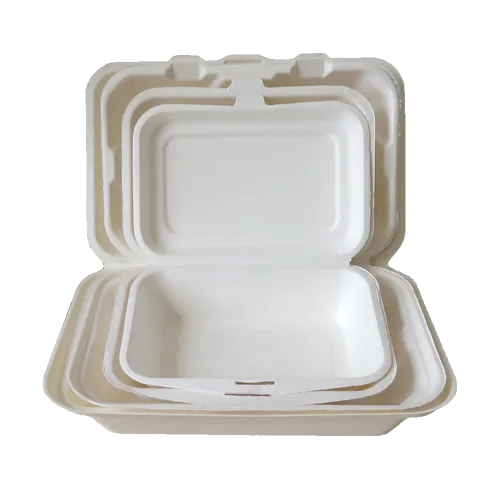
Bagasse clamshell box (square) — compostable tableware with snap-shut hinge.

Bagasse clamshell box (square) — compostable tableware with snap-shut hinge.

View on supplier site →
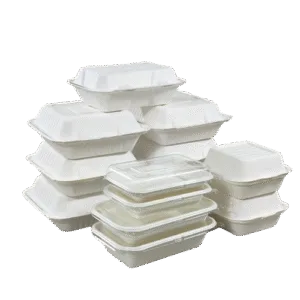
Biodegradable food container — single-compartment portion control format.

Biodegradable food container — single-compartment portion control format.

View on supplier site →
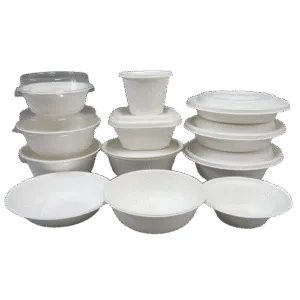
Sugarcane bagasse bowls with matching compostable lids — multi-size set.

Sugarcane bagasse bowls with matching compostable lids — multi-size set.

View on supplier site →

Material types and applications

MaterialDescriptionComposting standardBest for
Sugarcane bagasse (molded fiber)Fibrous byproduct of sugar production, molded under heat/pressure into shapeIndustrial compostable per EN 13432, BPI, OK Compost INDUSTRIALHot food (up to 100°C), oily food, microwave-safe; mainstream foodservice
Bamboo fiber moldedBamboo pulp molded similar to bagasseEN 13432, BPIPremium foodservice (lighter color, slightly higher cost)
Wheat straw moldedWheat-straw fiber moldedEN 13432, BPIMid-tier foodservice; popular in EU
PLA (polylactic acid)Bio-plastic from corn or sugarcane fermentationEN 13432 industrial composting only (NOT home compostable)Cold cups, clear packaging, cutlery
CPLA (crystallized PLA)Heat-resistant variant of PLAEN 13432Hot-drink lids, hot-food cutlery
PLA-coated paperPaper with thin PLA inner coating for water resistanceEN 13432 (with coating verification)Hot cups, soup containers, takeout cartons
Kraft paper (uncoated)Recycled or virgin kraft paperRecyclable (paper stream); compostableSandwich wrap, dry food, single-use plates
PHA / PHBV blendsPolyester from microbial fermentationEN 13432 + home-compostable in some formulationsPremium / specialty applications; emerging

Product categories and pricing

ProductMaterialTypical FOB China per pieceMOQ
Bagasse clamshell box (8×8×3 in / 200×200×76 mm)BagasseUSD 0.045-0.085 per piece10,000-20,000 pcs
Bagasse 3-compartment plate (10 in / 254 mm)BagasseUSD 0.038-0.075 per piece10,000-20,000 pcs
Bagasse round bowl (16-32 oz)BagasseUSD 0.035-0.085 per piece10,000-20,000 pcs
Bagasse plate (6-9 in)BagasseUSD 0.025-0.055 per piece15,000-30,000 pcs
Hot cup (8-16 oz, single wall)PLA-coated paperUSD 0.038-0.085 per piece50,000-100,000 pcs
Hot cup (12-20 oz, double wall)PLA-coated paperUSD 0.085-0.180 per piece50,000-100,000 pcs
Cold cup (16-24 oz)PLAUSD 0.045-0.110 per piece50,000-100,000 pcs
Cup lid (hot or cold, sized)CPLA or PLAUSD 0.018-0.055 per piece50,000-100,000 pcs
Cutlery set (fork + knife + spoon, wrapped)CPLA or woodUSD 0.038-0.075 per set20,000-50,000 sets
Single fork / spoon / knifeCPLA / PLA / woodUSD 0.012-0.038 per piece50,000+ pcs
Soup container (12-32 oz)PLA-coated paperUSD 0.085-0.220 per piece30,000-60,000 pcs
Sandwich wrap / kraftKraft paperUSD 0.018-0.055 per piece50,000+ pcs
Bagasse take-out box (food container)BagasseUSD 0.055-0.140 per piece10,000-25,000 pcs
Bamboo skewer / pickBambooUSD 0.0035-0.0085 per piece100,000+ pcs
Compostable strawsPLA / paperUSD 0.0085-0.025 per piece100,000+ pcs

Compliance certifications by destination market

MarketRequired certificationsCritical compliance points
European UnionEN 13432 industrial compostability; OK Compost INDUSTRIAL (TÜV Austria); EU 10/2011 food-contactSingle-Use Plastics Directive (SUPD) bans foam containers, plastic plates/cutlery; PFAS restrictions per EU regulation
USA (Federal)FDA food contact compliance; BPI (Biodegradable Products Institute) certificationState-level rules vary significantly; California prohibits PFAS in food contact (2023+); Maine, Washington, others follow
USA (California specifically)BPI + CalRecycle compliance + SB 343 Truth-in-Labeling"Compostable" label only with verified BPI certification; PFAS restrictions strict
UKEN 13432; UKCA marking for relevant itemsBan on plastic plates, cutlery, food containers (Oct 2023)
AustraliaAS 4736 industrial compostability; AS 5810 home compostability (premium)State bans on EPS, single-use plastics; varying timelines
CanadaBPI or equivalent; CFIA food-contact complianceFederal ban on certain single-use plastics (2022+); provincial rules
JapanJIS Q 14021 / J-bio plastic mark; food-contact per MHLWVoluntary at present; growing adoption

PFAS contamination — the biggest hidden compliance issue

Fluorinated chemicals (PFAS) have been used to add grease and water resistance to many compostable foodservice products. PFAS persist in environment and contaminate compost streams, defeating the sustainability claim. Multiple jurisdictions now prohibit PFAS in food-contact: California (2023), Maine (2023), Washington (2024), New York (2025), Maryland, Connecticut, Vermont, Rhode Island. EU restrictions tightening through REACH process.

For US-bound foodservice packaging, verify supplier provides PFAS-free certification with detection limits ≤100 ppm total fluorine. Reputable manufacturers like Bioleaderpack maintain PFAS-free product lines for North American export specifically. Suppliers offering "compostable" packaging without explicit PFAS testing documentation are red flags — non-compliant imports may be seized or trigger major recall costs.

Pricing brackets — wholesale

Order tierTotal quantityDiscountContainer utilizationLead time
Sample / test market5,000-25,000 pcsList priceAir freight or LCL15-30 days
Small foodservice operator50,000-300,000 pcs5-12%LCL or 20' container25-40 days
Mid distributor / regional chain500,000-2,500,000 pcs12-22%40' or 40HQ container35-60 days
National foodservice / brand program5,000,000+ pcs annually22-32%40HQ x N containers50-90 days

Common buyer profiles

Buyer typeTypical order patternQuality priorities
Small restaurant / caféOrder via local distributor; bulk packs 250-500 pieces per caseCost; basic compliance; brand-print optional
Chain restaurant (regional)10,000-100,000 pieces per quarter; standardized SKUsBPI/EN 13432 certification; consistent specification
National foodservice chainMulti-million piece annual contracts; national distributionFull compliance dossier; PFAS-free certification; multiple-source contingency
Foodservice distributorContainer-scale orders across 50-200 SKUs; private-label optionCatalog breadth; reliable supply chain; competitive pricing
Hospital / institutionQuarterly orders of standard SKUs; food-safety priorityFood-contact compliance; stable supply; consistent quality
Hotel / cateringSeasonal peaks; mid-volume; brand-printed oftenPremium appearance; brand consistency; reliable delivery
School / university foodserviceAnnual contracts; institutional volumeCost; compliance; bulk packaging
Event / catering companyProject-based orders; varied SKUsPremium appearance; appropriate specs for menu type

Order workflow — compostable foodservice procurement

  1. Application analysis — map menu items to required packaging (hot food / cold food / dry / soup / drinks); calculate annual consumption per SKU
  2. Compliance specification — verify destination-market requirements (BPI for US, EN 13432 for EU/UK, AS 4736 for Australia); explicit PFAS-free for North American imports
  3. Sample order — 50-500 pieces of each candidate SKU; test functional performance (heat, oil, moisture, microwave); test customer acceptance (does it feel premium / does it leak / does it crack)
  4. Compliance verification — receive copies of BPI / EN 13432 / OK Compost / AS 4736 certificates; verify with certifying body authentic + current
  5. First container order — 30-60 SKUs, 10,000-100,000 pcs each based on consumption; specify packaging (master case count, individual case sleeve)
  6. Quality acceptance — incoming inspection for moisture content (bagasse), structural integrity (no cracks), print accuracy (if branded), packaging integrity
  7. Series replenishment — quarterly to bi-monthly orders; build relationships with 2-3 alternative suppliers for redundancy on high-volume SKUs

Bioleaderpack on weisourcing.com

View the full supplier profile, certifications, contact details, and complete product catalogue.

Frequently asked questions

What's the practical difference between "biodegradable" and "compostable"?
Significant regulatory and functional difference. BIODEGRADABLE — vague term meaning the material will eventually break down through biological processes. No specific timeframe, environment, or completeness required. In jurisdictions like California (SB 343) and EU, "biodegradable" claims are increasingly restricted because the term is too vague to be meaningful for environmental marketing. COMPOSTABLE (specifically) — the material breaks down completely under composting conditions within a defined timeframe (typically 12 weeks for industrial compostable, 12-24 months for home compostable) leaving no toxic residues. Specific standards: EN 13432 / ASTM D6400 (industrial compostable); EN 13432 + OK Compost HOME / AS 5810 (home compostable). Industrial compostable requires high-temperature composting facility (55°C+); home compostable works in backyard compost. Practical implications: (1) Marketing claim — "biodegradable" without specifics is increasingly problematic; "compostable" with certification is safer; (2) End-of-life management — industrial compostable foodservice packaging needs commercial composting infrastructure; without it, materials end up in landfill where they decompose much slower; (3) Consumer behavior — customers often confuse the terms; clear labeling required by SB 343 and similar laws. For foodservice operators, work with suppliers providing specific compostability certifications matching destination-market regulations; avoid generic "biodegradable" claims in product specifications.
Can I rely on Chinese aftermarket-fit compostable packaging to meet EU and US compliance?
For premium-tier suppliers maintaining current certifications, yes. Compliance verification framework: (1) CERTIFICATE AUTHENTICITY — request actual certification document from BPI (USA) or TÜV Austria (EU OK Compost); verify online with the certifying body using the certificate number. Counterfeit certificates are not uncommon in lower-tier supply. (2) CERTIFICATE SCOPE — verify the certificate covers your specific SKU (size, material formulation, color, coating); generic facility certification is insufficient. (3) PFAS-FREE DOCUMENTATION — for North American imports, separate PFAS test certificate (typically EPA Method 537.1, total fluorine ≤100 ppm); without this, California / Maine / Washington shipments are non-compliant. (4) FOOD CONTACT COMPLIANCE — FDA food-contact substance notification or EU 10/2011 declaration of compliance. PRACTICAL APPROACH: work with suppliers like Bioleaderpack who can provide all four documents per shipment. Verify documents annually as compliance regulations evolve. For mainstream foodservice operations, premium aftermarket-fit Chinese packaging at 60-75% of US/EU domestic pricing delivers full compliance at significant cost savings. For risk-averse buyers (national chains, public agencies), maintain dual-source supply with both Chinese aftermarket and at least one domestic-region producer for supply chain resilience.
How does the cost of compostable packaging compare to traditional plastic?
Bagasse and PLA compostable packaging typically costs 1.5-3x equivalent plastic per piece. Specific examples: PLASTIC clamshell takeout (PS or PP) 8x8 inch: USD 0.025-0.045 per piece. BAGASSE clamshell same size: USD 0.045-0.085 per piece. Markup ratio: ~1.8-2.0x. Similar ratios across hot cups, cold cups, cutlery, plates. PRICE GAP NARROWING: (1) Scale economies in compostable production growing 25-40% per year; (2) Plastic packaging facing increasing taxes and bans, raising effective price; (3) Customer preference for compostable allows premium pricing; (4) Many municipalities now require compostable for foodservice — eliminating choice. ECONOMIC IMPLICATIONS for foodservice operators: (1) DIRECT COST: compostable adds USD 0.02-0.10 per customer transaction depending on packaging mix. For typical fast-casual restaurant with USD 12 average ticket, packaging cost goes from 1-1.5% to 2-2.5% of revenue. (2) INDIRECT BENEFIT: premium positioning, customer satisfaction, regulatory compliance, brand value. Research consistently shows customers prefer compostable + may pay slightly higher prices when compostable is visible/marketed. (3) DISPOSAL COST: where commercial composting infrastructure exists (most US/EU markets now), disposal costs similar to landfill; some markets actually cheaper. NET OUTCOME: compostable packaging is now economically rational even without considering regulatory compliance or sustainability marketing — and economically mandatory in markets banning plastic foodservice items.
What are the most common product failures with compostable packaging?
Five common failure modes and how to prevent them. (1) HEAT FAILURE — bagasse softens at extreme heat (typically OK to 100°C, but extended hot food contact can cause structural softening). PREVENTION: specify heat-resistant variant for hot soup applications; verify with samples on actual product. (2) GREASE FAILURE — uncoated bagasse can absorb grease through walls. PREVENTION: specify PFAS-free grease-resistant coating (most premium suppliers use grease-resistant bagasse without PFAS); verify with sample testing on greasy foods. (3) MICROWAVE WARPING — some compostable materials warp in microwave despite "microwave-safe" claim. PREVENTION: test with actual microwave conditions on samples; specify microwave-tested if microwave use is expected. (4) LID-BASE FIT FAILURE — manufacturing tolerance issues cause loose-fitting lids that pop off in delivery; this is a major customer complaint source. PREVENTION: specify dimensional tolerance ±0.5mm; sample-test fit consistency across multiple production batches. (5) STORAGE DEGRADATION — bagasse absorbs moisture in humid storage; extended storage above 60% relative humidity can cause stickiness or mold. PREVENTION: store in low-humidity environment; rotate inventory FIFO; avoid long-term storage. PROACTIVE QC for foodservice operators: receive each shipment, sample 1-2% for heat/grease/structural testing on actual menu items; document any issues with supplier; switch suppliers if quality declines. The 2-3x cost premium over plastic only makes sense if compostable performs functionally — quality control matters.
What's the right SKU mix for a new foodservice operator transitioning to compostable?
Strategic transition framework. PHASE 1 — VISIBLE-TO-CUSTOMER ITEMS (highest sustainability marketing impact): hot cups + cold cups + cutlery + plates (items customers see and use). Customers immediately notice compostable cups and forks; operators can market the change visibly. Cost impact 1.5-2x baseline. Implementation: 30-60 days. PHASE 2 — TAKEOUT CONTAINERS: clamshell boxes, soup containers, sandwich wraps. Customer-visible at takeout. Operational complexity moderate (more SKU variants for menu match). Implementation: 60-120 days after Phase 1. PHASE 3 — BACK-OF-HOUSE: gloves, prep sheets, food storage bags. Less visible but supports comprehensive sustainability claims. Operational complexity higher (more SKUs). Implementation: 6-12 months. SKU MIX RECOMMENDATIONS for typical fast-casual restaurant: 6-12 hot cup sizes (8/12/16/20 oz singles + doubles); 4-8 cold cup sizes; 4-6 plate/bowl variants; 2-4 clamshell sizes; cutlery (fork/knife/spoon individual + wrapped sets); straws; soup containers. Total 20-40 active SKUs. INVENTORY PLANNING: 4-8 weeks consumption stock initially (build up during transition); 2-4 weeks once stable. STAFF TRAINING: many compostable items handle slightly differently from plastic equivalents — train staff on proper handling, microwaving, customer education. CUSTOMER COMMUNICATION: signage explaining the change; cost-benefit messaging; disposal guidance (commercial compost vs landfill in your area).
How does the Single-Use Plastics Directive (SUPD) in the EU affect my product specifications?
EU SUPD (Directive 2019/904) bans specific single-use plastic items and adds extended producer responsibility for others. PROHIBITED ITEMS (no compostable equivalent allowed if made of plastic): EPS food containers, EPS cups, plastic plates and cutlery, plastic straws, plastic stir sticks, plastic balloon sticks, cotton bud sticks (with plastic stick), oxo-degradable products. RESTRICTIONS APPLYING TO COMPOSTABLE EQUIVALENTS: (1) "PLASTIC" in SUPD includes some bioplastics — PLA cutlery and plates are subject to the ban in some interpretations; check with specific national implementation. (2) Conventional cardboard with PE coating is sometimes treated as plastic for SUPD purposes; PLA-coated paper and pure paper variants are typically OK. (3) Tethered caps required on beverage containers (separate requirement). (4) Recycled content requirements scaling up: 25% by 2025, 30% by 2030 for PET beverage bottles. NATIONAL IMPLEMENTATIONS VARY: Germany, France, Italy, Netherlands, Spain each implement SUPD differently — some interpret PLA strictly, others allow PLA where biological substitution is the alternative to plastic. PRACTICAL IMPLICATIONS: (1) Specify bagasse or molded fiber alternatives where PLA is at risk (especially for plates and cutlery in Germany, France); (2) Verify supplier knows current implementation in your destination country; (3) Build flexibility for product spec changes as national rules evolve. Bioleaderpack and similar premium suppliers maintain country-specific product variants for major EU markets; verify before commercial commitment.
⚠ Important Disclaimer

Source: Product images on this page are hosted on the manufacturer's official website (bioleaderpack.com) and link directly back to that website. All product information was summarised from the supplier's public catalogue.

Compliance and regulatory caution: Compostable foodservice packaging regulations vary significantly and are evolving rapidly. Single-Use Plastics Directives, PFAS restrictions, BPI / EN 13432 / OK Compost / AS 4736 certification requirements, and food-contact compliance (FDA, EU 10/2011, MHLW) all require verification per destination market. Buyers are responsible for ensuring full compliance — including current certification status, PFAS-free testing, and labeling per destination market. Non-compliant imports may be seized or trigger major recall costs. Verify all regulations and certifications at order time as compliance landscape evolves continuously.

Disposal infrastructure caveat: Industrial compostable foodservice packaging requires commercial composting facilities (typically 55°C+ thermophilic composting). In jurisdictions without commercial compost infrastructure, "compostable" packaging behaves similarly to traditional packaging in landfill — with somewhat slower decomposition than plastic. The environmental benefit of compostable packaging depends significantly on local disposal infrastructure. Communicate this to customers transparently rather than overstating environmental benefits.

Pricing & specifications: All price ranges, MOQ values, and specifications reflect general market observation. Real-world pricing fluctuates with raw material costs (sugarcane bagasse, PLA, paper pulp), labor, and freight. Confirm current pricing, MOQ, lead time, and configuration directly with the supplier.

No middleman role: Weisourcing provides supplier discovery and editorial content. All transactions occur directly between buyer and supplier through the contact channels published on the supplier's official website.